Skip to content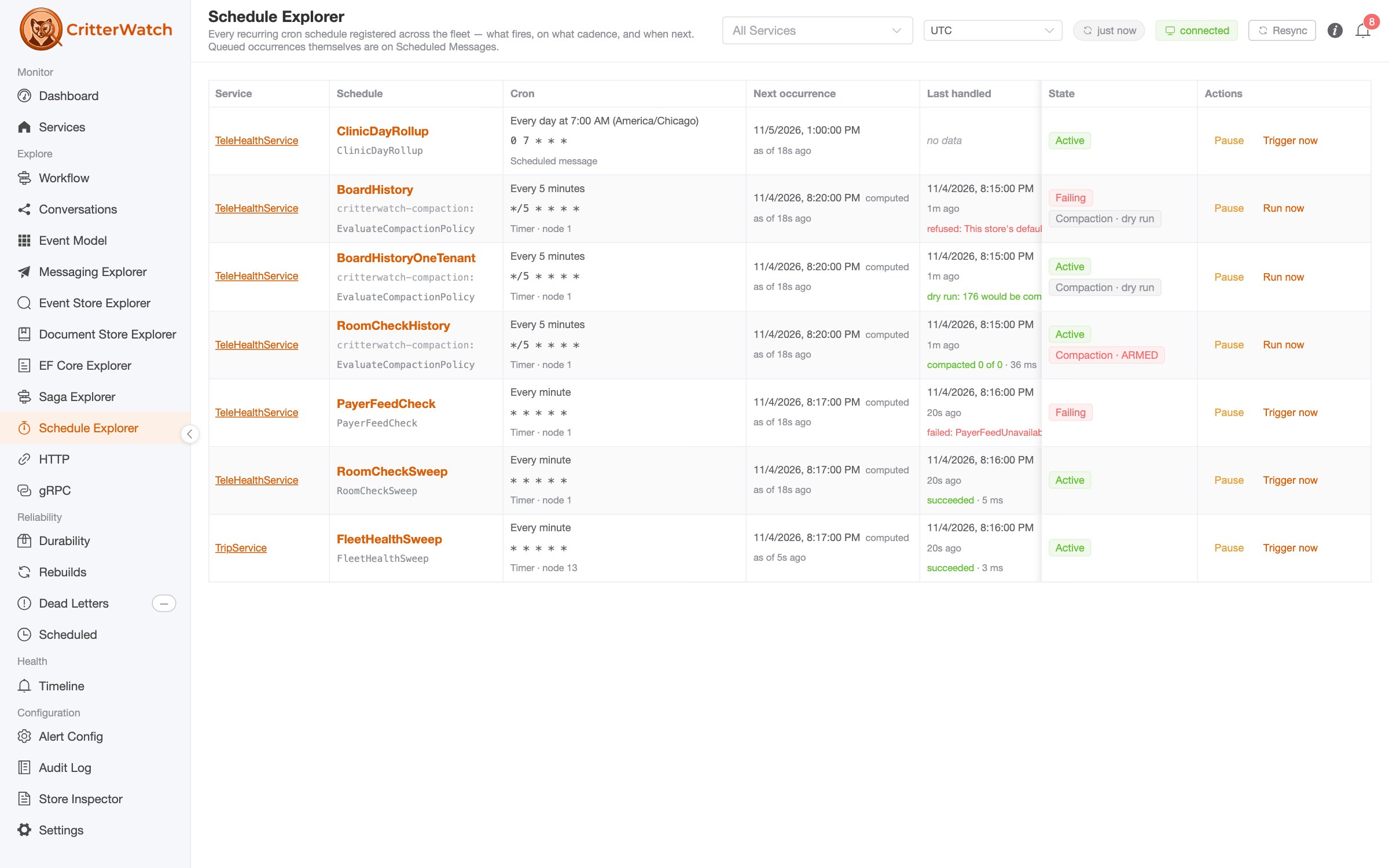 4th November 2026Recurring Jobs with Wolverine and CritterWatchEvery system has work that runs on a schedule. Wolverine turns a cron job into an ordinary message, so it gets the outbox, retries, dead letters, OpenTelemetry tracing and once-per-cluster execution for free, and CritterWatch 1.2 lets you see, pause, resume and trigger every schedule across your fleet. Plus how Wolverine treats a nightly job differently from one that fires every few seconds, and why.
 3rd November 2026Critter Stack AI Skills 1.18: Caught Up With CritterWatch 1.2AI Skills 1.18 brings every CritterWatch skill up to the 1.2 MCP tools, checked tool by tool against the source: a new sagas skill, the get_command_outcome tool, dead letters ranged by failure time, event queries over bodies and metadata, and six corrections to advice that had gone wrong, including the Prometheus series names every Grafana example used.
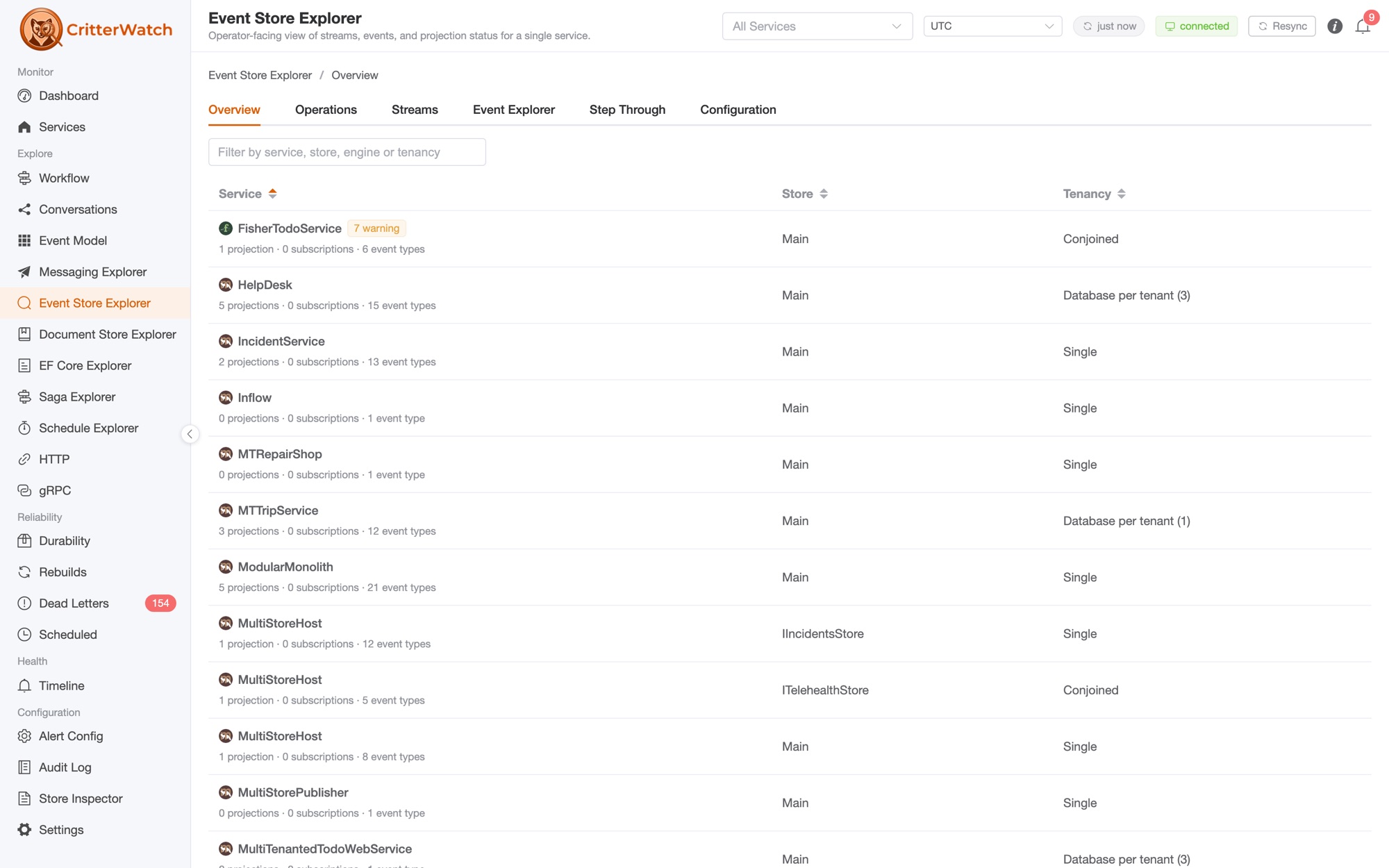 3rd November 2026CritterWatch 1.2: See Inside Your Event Store, Documents, Sagas and SchedulesCritterWatch 1.2 turns the console into a real explorer for what your Critter Stack services hold: an overview of every event store, a Step Through tab for projections, a Document Store Explorer that checks your documents still deserialize, saga instances with their state and pending timeouts, a Schedule Explorer that tells you what a schedule is actually doing, and an Event Model you can drill into.
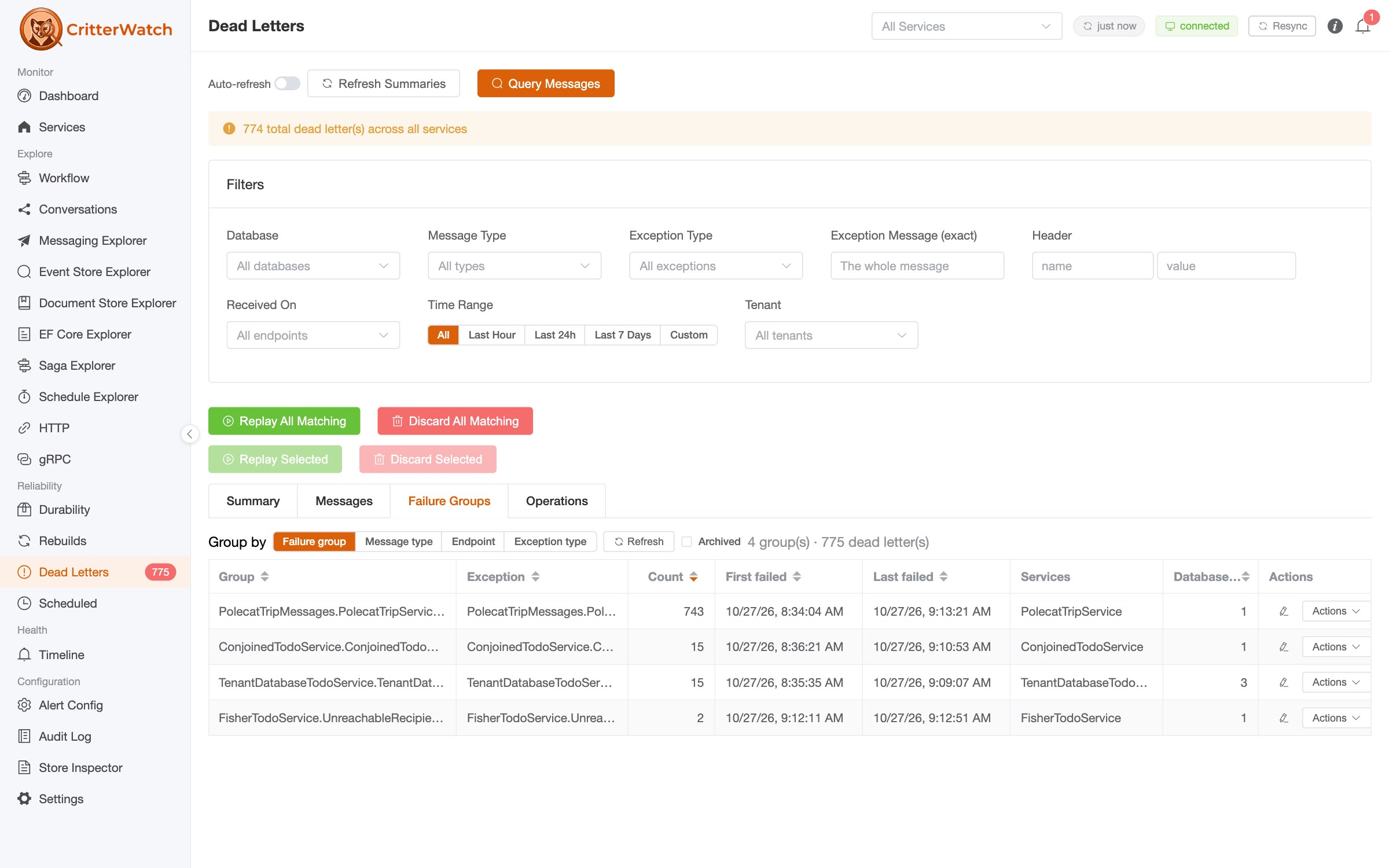 29th October 2026Failure Groups: Handle a Dead Letter Incident as One ThingCritterWatch 1.1 groups dead letters by the failure that caused them, across every service and database, and lets you replay, archive, restore or discard the whole group as one tracked operation with a reason attached. Your AI agent gets the same loop over MCP, and still has to show you the preview before it deletes anything.
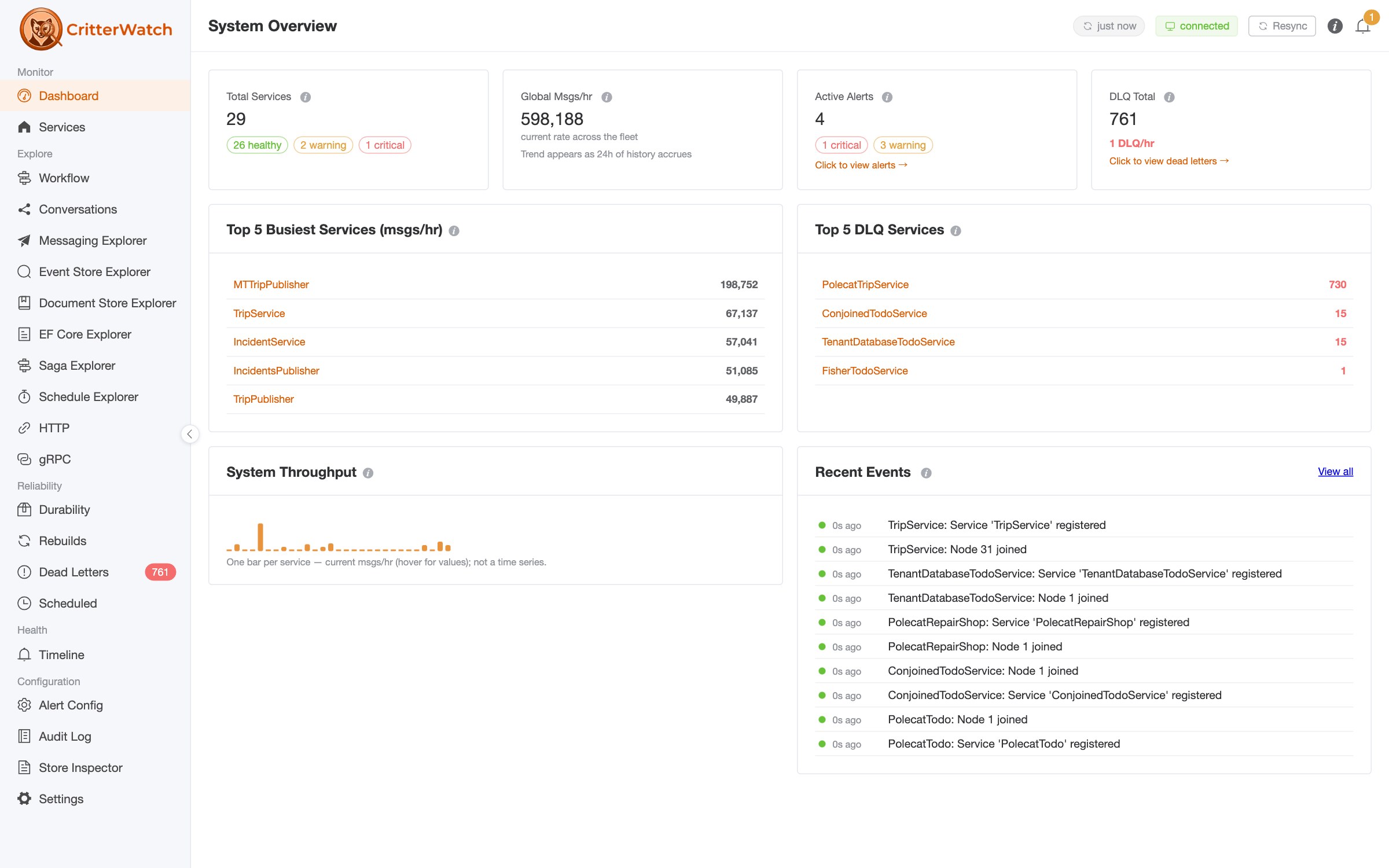 27th October 2026CritterWatch 1.1, Bobcat 1.0, AI Skills 1.17, and a First Look at StoatOne release wave, four products: CritterWatch 1.1 with 83 MCP tools, cron schedules, a Document Explorer and a long list of scalability fixes earned on real systems; Bobcat 1.0, the successor to Storyteller and our answer for spec-driven development; AI Skills 1.17; and the first public preview of Stoat.27th October 2026Critter Stack AI Skills 1.17: One Month of Releases, Checked Against the SourceAI Skills 1.17 is the result of a review of everything Wolverine, Marten, CritterWatch, Bobcat and Stoat shipped in the last month, checked against the product source rather than the changelogs. Thirty-six skill changes, seven of them correcting advice that had quietly gone wrong, and the CritterWatch 1.1 paired updates that were waiting in 1.16.
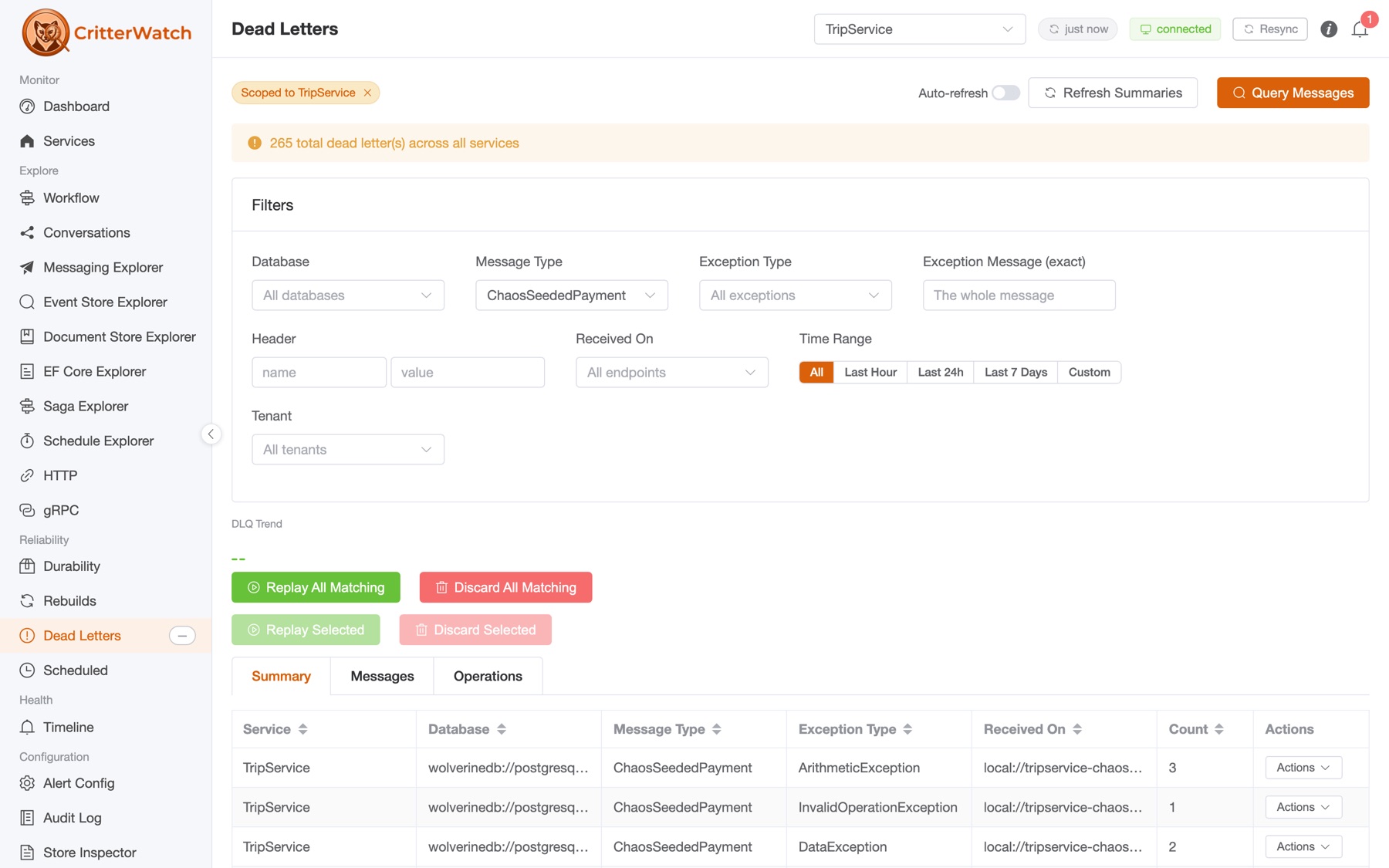 25th October 2026Dead Letter Management in CritterWatch 1.1Bulk replay that acts on exactly what it counted, edit-and-replay with a full audit trail, every operation followed to the end across every database, and an MCP server that lets an AI agent triage your dead letters, but asks before it deletes anything.
 30th September 2026Event Sourcing on SQL Server with PolecatIf your shop runs on SQL Server and you've been eyeing Event Sourcing, Polecat is the most full featured event store you can get for SQL Server in .NET. It's built on the same shared infrastructure and a decade of production lessons from Marten, it has a first class Wolverine integration for CQRS, CritterWatch can monitor it, and JasperFx Software supports it. Here's the tour.
 28th September 2026Introducing the Bobcat Supervisor for Reliable .NET Integration SuitesBobcat.Supervisor splits a .NET integration test suite across worker processes, isolates each worker's database, retries failures in a fresh process without hiding them, and names the test that hung. It already runs Wolverine's CI and CritterWatch's test gate, and your test project doesn't need to reference Bobcat at all.
 24th September 2026CritterWatch 1.1: Run the Console Inside Your Own ApplicationCritterWatch 1.1 adds embedded mode — mount the monitoring console inside the Wolverine application you already run, on the PostgreSQL you already have, with no second deployment and no message broker. Two calls, one database, and the console watches the app it lives in.
 23rd September 2026Critter Stack AI Skills 1.14: Troubleshooting Guides, and Why the Skills Pay for ThemselvesAI Skills 1.14 ships eight troubleshooting skills that decode Critter Stack exceptions from the stack trace. It's also a good excuse to make the bigger case: skills that know Wolverine's idioms produce terser code, cheaper agent sessions, and an agent that can actually reason through concurrency, parallelism, and production diagnostics.
 22nd September 2026Multi-Tenancy with EF Core is a Whole Lot Easier with WolverineEF Core query filters and dynamic connection strings are the raw ingredients for multi-tenancy. Wolverine turns them into a finished dish: conjoined tenancy with zero filter plumbing, database per tenant, tenants added at runtime, HTTP tenant detection that flows straight into DbContext construction, a transactional inbox/outbox per tenant database, tenant ids that ride along on every cascaded message, and 'it just works' schema migrations across every tenant database.3rd September 2026LLM Callouts in WolverineWolverineFx.AI adds LLM callouts to Wolverine — one-shot calls to a large language model modeled as ordinary messages, so they get the transactional outbox, retries, back pressure, budgets, and testability for free. The first thing JasperFx is building on it is AI Assisted Production Support in CritterWatch 1.1.
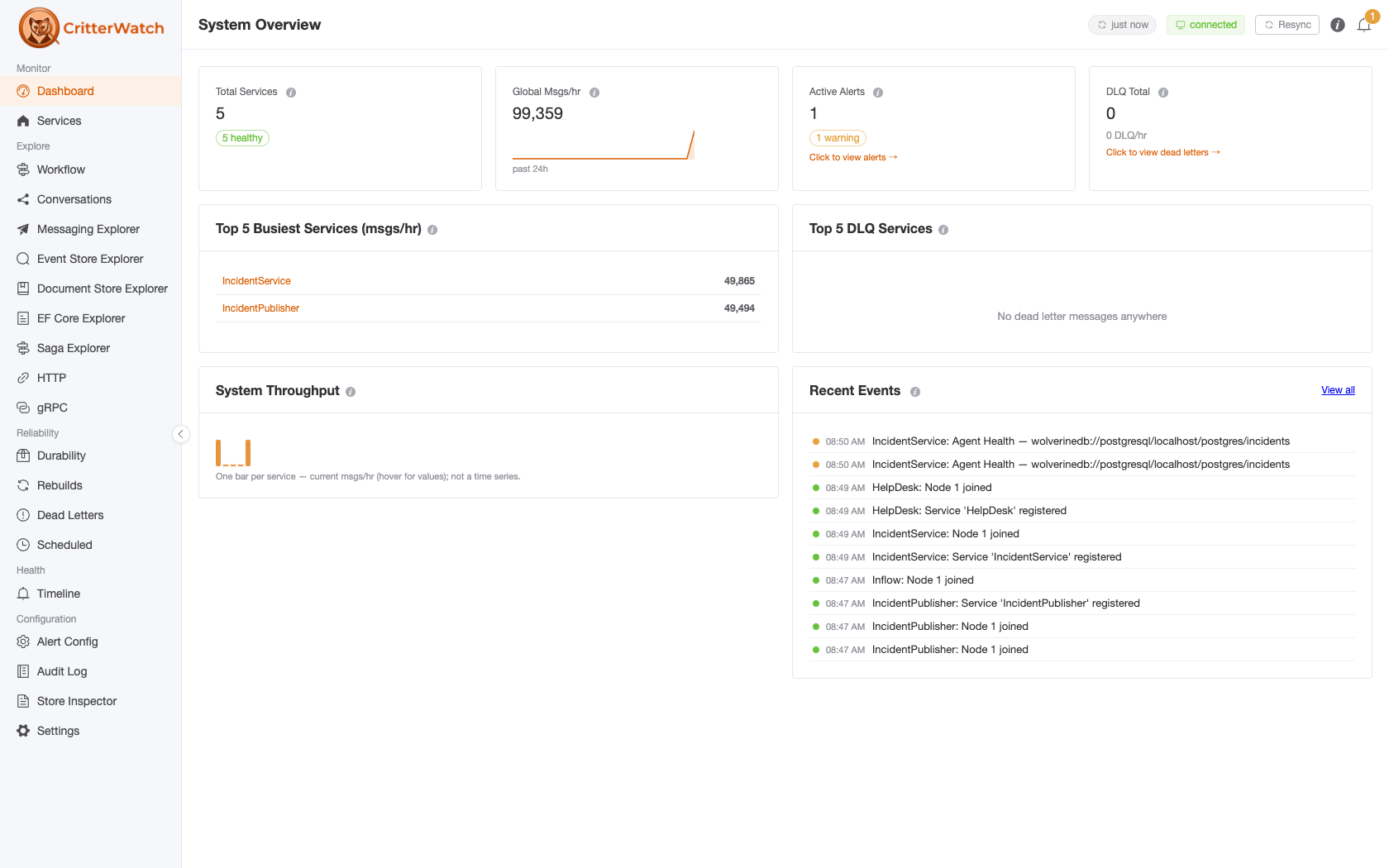 31st August 2026Interrogating Your Running System with CritterWatch's MCP ServerA real, recorded session of an AI agent triaging a Wolverine system through CritterWatch's MCP server — summarizing and replaying dead letters, explaining a message's full journey from its OpenTelemetry spans, chasing down a poisoned projection with the projection stepper, and interrogating the alert subsystem. Plus how the JasperFx AI Skills teach the agent to do all of this well.26th August 2026Alerts and the Timeline in CritterWatch 1.0CritterWatch 1.0 is watching your system for unusual conditions and trying to explain the cause and effect of anything that's going wrong.20th August 2026CritterWatch 1.0: Stop Guessing What Your Critter Stack Is DoingCritterWatch 1.0 is here — a monitoring and production-management console purpose-built for Wolverine, Marten, Polecat, and Fisher. It renders the system you actually shipped from the running code, steps through projections event by event, lets you replay dead letters and rebuild projections without a redeploy, and hands your AI agent a real, RBAC-gated control surface.
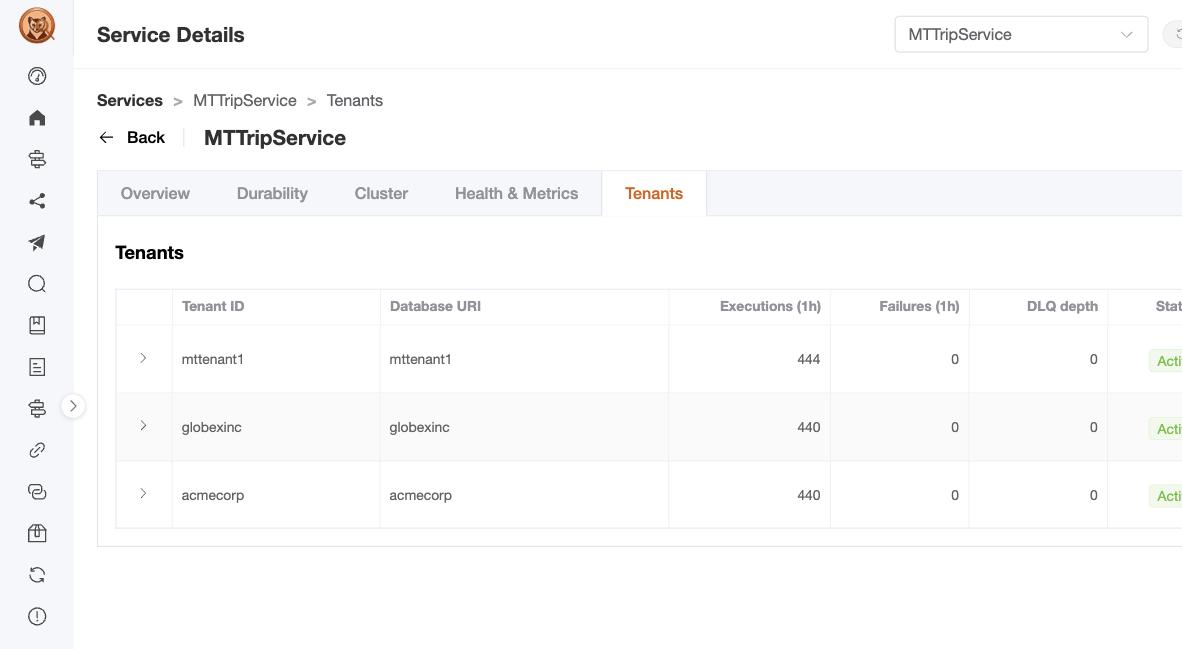 28th July 2026Onboard a Tenant Without a Deployment: Runtime Multi-Tenancy in CritterWatchCritter Stack services can add, disable, and remove tenants at runtime — new databases and all. CritterWatch turns that capability into an operator console: a tenant lifecycle you can drive from a browser, and performance metrics broken down per tenant id.
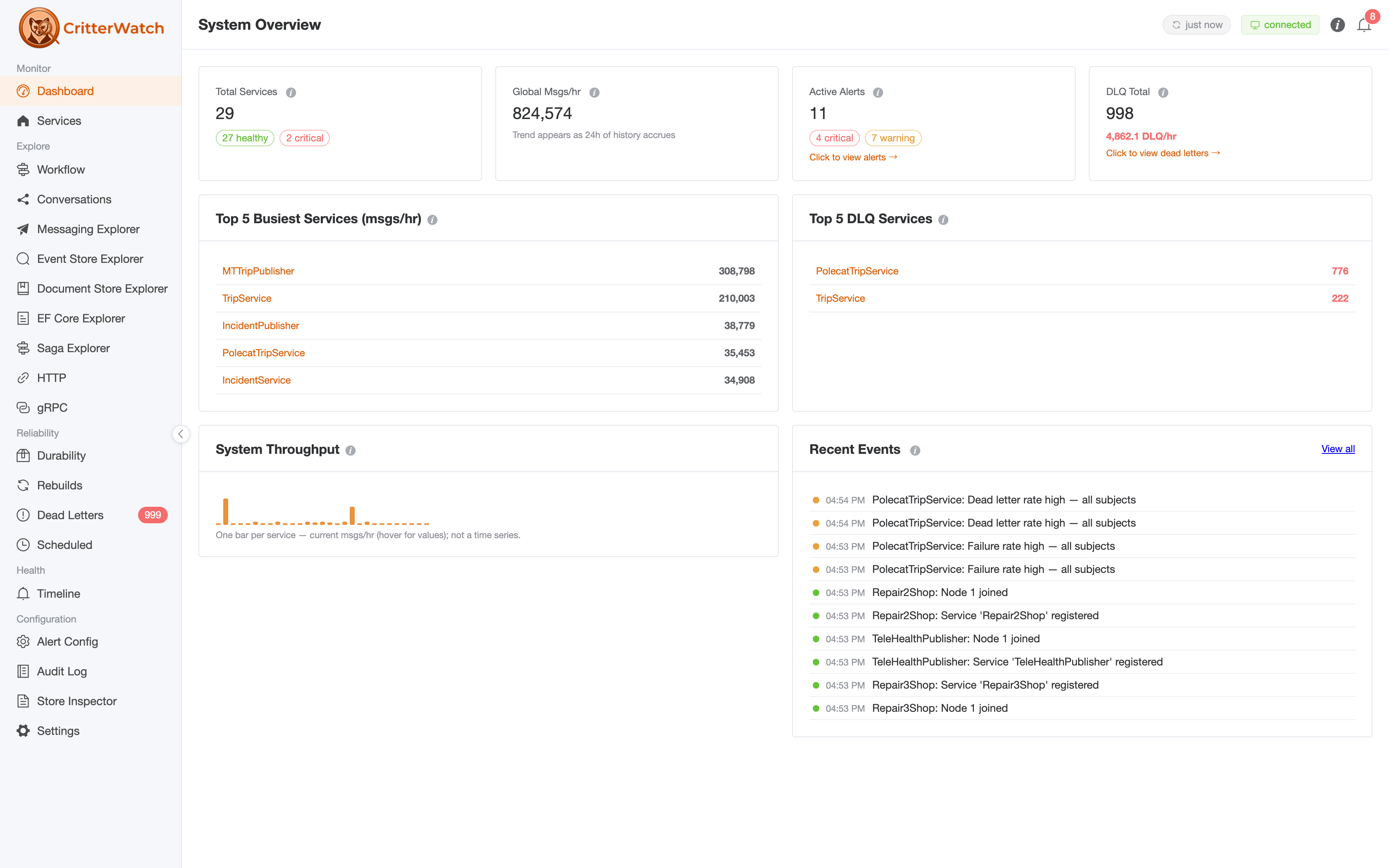 27th July 2026Announcing CritterWatch 1.0 RC 1The first release candidate for CritterWatch 1.0 — a purpose-built monitoring and operations console for the Critter Stack that shows you the system you actually shipped, watches it for you, hands your AI assistant a real control surface, and gives you a proper cockpit for the event store.
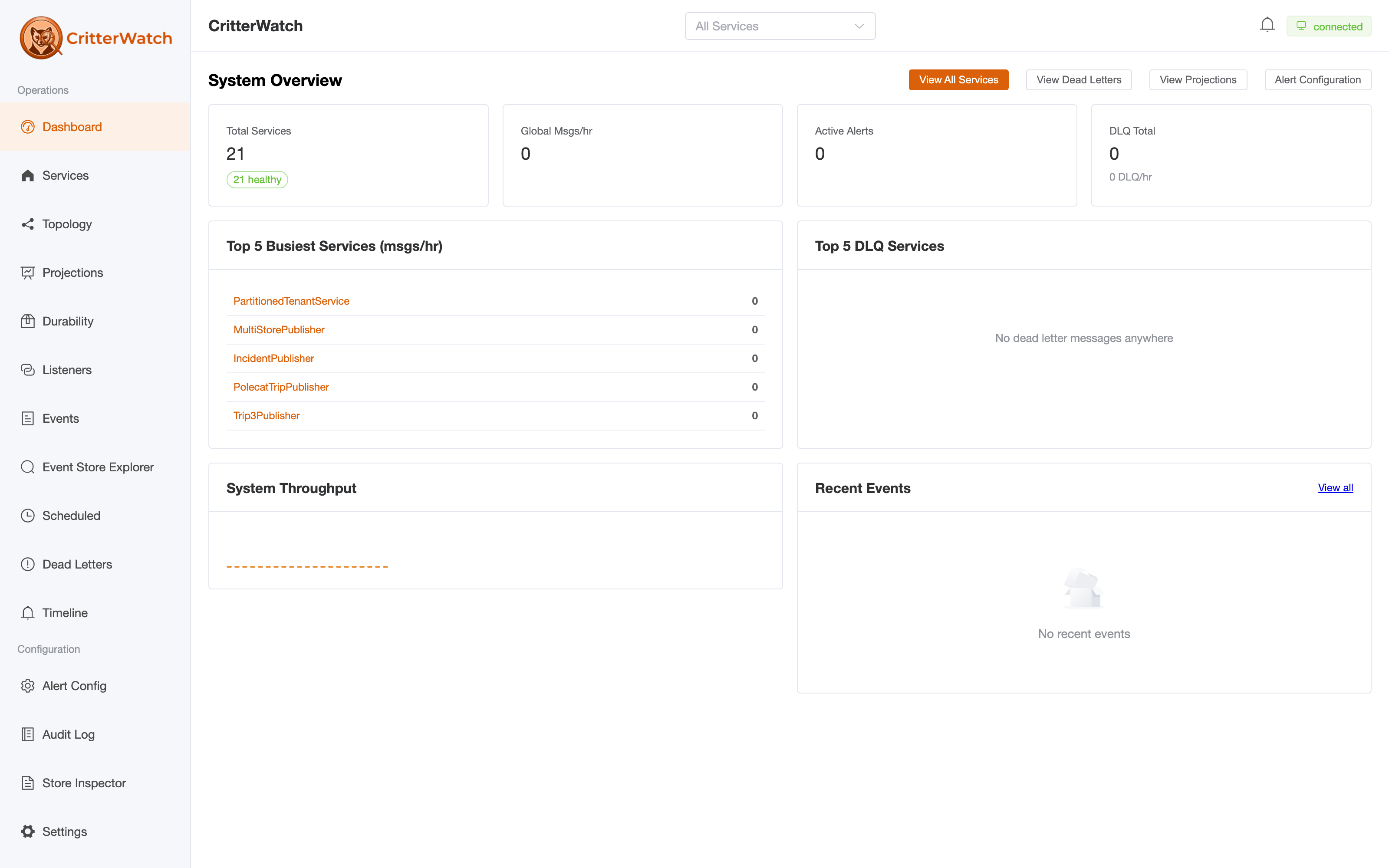 16th June 2026Introducing CritterWatch: Someone to Keep an Eye on the CrittersCritterWatch 1.0.0-alpha.1 is loose on NuGet — a monitoring and production-management console for Wolverine, Marten, and Polecat that doubles as dev-time insight and an MCP control surface for your AI agents.
 7th June 2026Announcing CritterWatch 0.8.0CritterWatch 0.8.0 is the largest release yet — a purpose-built monitoring and operations console for the Critter Stack with production observability, development-time insight, and an MCP control surface built for AI agents.
 2nd April 2025A Quick Note about Our Plans for Marten and WolverineAs competing .NET tools move to paid licenses, Marten and Wolverine stay MIT licensed under JasperFx's open core model, with services, support plans, and CritterWatch funding the work.

CritterWatch posts
Everything we have written about CritterWatch
4th November 2026Recurring Jobs with Wolverine and CritterWatchEvery system has work that runs on a schedule. Wolverine turns a cron job into an ordinary message, so it gets the outbox, retries, dead letters, OpenTelemetry tracing and once-per-cluster execution for free, and CritterWatch 1.2 lets you see, pause, resume and trigger every schedule across your fleet. Plus how Wolverine treats a nightly job differently from one that fires every few seconds, and why.3rd November 2026Critter Stack AI Skills 1.18: Caught Up With CritterWatch 1.2AI Skills 1.18 brings every CritterWatch skill up to the 1.2 MCP tools, checked tool by tool against the source: a new sagas skill, the get_command_outcome tool, dead letters ranged by failure time, event queries over bodies and metadata, and six corrections to advice that had gone wrong, including the Prometheus series names every Grafana example used.3rd November 2026CritterWatch 1.2: See Inside Your Event Store, Documents, Sagas and SchedulesCritterWatch 1.2 turns the console into a real explorer for what your Critter Stack services hold: an overview of every event store, a Step Through tab for projections, a Document Store Explorer that checks your documents still deserialize, saga instances with their state and pending timeouts, a Schedule Explorer that tells you what a schedule is actually doing, and an Event Model you can drill into.29th October 2026Failure Groups: Handle a Dead Letter Incident as One ThingCritterWatch 1.1 groups dead letters by the failure that caused them, across every service and database, and lets you replay, archive, restore or discard the whole group as one tracked operation with a reason attached. Your AI agent gets the same loop over MCP, and still has to show you the preview before it deletes anything.27th October 2026CritterWatch 1.1, Bobcat 1.0, AI Skills 1.17, and a First Look at StoatOne release wave, four products: CritterWatch 1.1 with 83 MCP tools, cron schedules, a Document Explorer and a long list of scalability fixes earned on real systems; Bobcat 1.0, the successor to Storyteller and our answer for spec-driven development; AI Skills 1.17; and the first public preview of Stoat.27th October 2026Critter Stack AI Skills 1.17: One Month of Releases, Checked Against the SourceAI Skills 1.17 is the result of a review of everything Wolverine, Marten, CritterWatch, Bobcat and Stoat shipped in the last month, checked against the product source rather than the changelogs. Thirty-six skill changes, seven of them correcting advice that had quietly gone wrong, and the CritterWatch 1.1 paired updates that were waiting in 1.16.25th October 2026Dead Letter Management in CritterWatch 1.1Bulk replay that acts on exactly what it counted, edit-and-replay with a full audit trail, every operation followed to the end across every database, and an MCP server that lets an AI agent triage your dead letters, but asks before it deletes anything.30th September 2026Event Sourcing on SQL Server with PolecatIf your shop runs on SQL Server and you've been eyeing Event Sourcing, Polecat is the most full featured event store you can get for SQL Server in .NET. It's built on the same shared infrastructure and a decade of production lessons from Marten, it has a first class Wolverine integration for CQRS, CritterWatch can monitor it, and JasperFx Software supports it. Here's the tour.28th September 2026Introducing the Bobcat Supervisor for Reliable .NET Integration SuitesBobcat.Supervisor splits a .NET integration test suite across worker processes, isolates each worker's database, retries failures in a fresh process without hiding them, and names the test that hung. It already runs Wolverine's CI and CritterWatch's test gate, and your test project doesn't need to reference Bobcat at all.24th September 2026CritterWatch 1.1: Run the Console Inside Your Own ApplicationCritterWatch 1.1 adds embedded mode — mount the monitoring console inside the Wolverine application you already run, on the PostgreSQL you already have, with no second deployment and no message broker. Two calls, one database, and the console watches the app it lives in.23rd September 2026Critter Stack AI Skills 1.14: Troubleshooting Guides, and Why the Skills Pay for ThemselvesAI Skills 1.14 ships eight troubleshooting skills that decode Critter Stack exceptions from the stack trace. It's also a good excuse to make the bigger case: skills that know Wolverine's idioms produce terser code, cheaper agent sessions, and an agent that can actually reason through concurrency, parallelism, and production diagnostics.22nd September 2026Multi-Tenancy with EF Core is a Whole Lot Easier with WolverineEF Core query filters and dynamic connection strings are the raw ingredients for multi-tenancy. Wolverine turns them into a finished dish: conjoined tenancy with zero filter plumbing, database per tenant, tenants added at runtime, HTTP tenant detection that flows straight into DbContext construction, a transactional inbox/outbox per tenant database, tenant ids that ride along on every cascaded message, and 'it just works' schema migrations across every tenant database.3rd September 2026LLM Callouts in WolverineWolverineFx.AI adds LLM callouts to Wolverine — one-shot calls to a large language model modeled as ordinary messages, so they get the transactional outbox, retries, back pressure, budgets, and testability for free. The first thing JasperFx is building on it is AI Assisted Production Support in CritterWatch 1.1.31st August 2026Interrogating Your Running System with CritterWatch's MCP ServerA real, recorded session of an AI agent triaging a Wolverine system through CritterWatch's MCP server — summarizing and replaying dead letters, explaining a message's full journey from its OpenTelemetry spans, chasing down a poisoned projection with the projection stepper, and interrogating the alert subsystem. Plus how the JasperFx AI Skills teach the agent to do all of this well.26th August 2026Alerts and the Timeline in CritterWatch 1.0CritterWatch 1.0 is watching your system for unusual conditions and trying to explain the cause and effect of anything that's going wrong.20th August 2026CritterWatch 1.0: Stop Guessing What Your Critter Stack Is DoingCritterWatch 1.0 is here — a monitoring and production-management console purpose-built for Wolverine, Marten, Polecat, and Fisher. It renders the system you actually shipped from the running code, steps through projections event by event, lets you replay dead letters and rebuild projections without a redeploy, and hands your AI agent a real, RBAC-gated control surface.28th July 2026Onboard a Tenant Without a Deployment: Runtime Multi-Tenancy in CritterWatchCritter Stack services can add, disable, and remove tenants at runtime — new databases and all. CritterWatch turns that capability into an operator console: a tenant lifecycle you can drive from a browser, and performance metrics broken down per tenant id.27th July 2026Announcing CritterWatch 1.0 RC 1The first release candidate for CritterWatch 1.0 — a purpose-built monitoring and operations console for the Critter Stack that shows you the system you actually shipped, watches it for you, hands your AI assistant a real control surface, and gives you a proper cockpit for the event store.16th June 2026Introducing CritterWatch: Someone to Keep an Eye on the CrittersCritterWatch 1.0.0-alpha.1 is loose on NuGet — a monitoring and production-management console for Wolverine, Marten, and Polecat that doubles as dev-time insight and an MCP control surface for your AI agents.7th June 2026Announcing CritterWatch 0.8.0CritterWatch 0.8.0 is the largest release yet — a purpose-built monitoring and operations console for the Critter Stack with production observability, development-time insight, and an MCP control surface built for AI agents.2nd April 2025A Quick Note about Our Plans for Marten and WolverineAs competing .NET tools move to paid licenses, Marten and Wolverine stay MIT licensed under JasperFx's open core model, with services, support plans, and CritterWatch funding the work.