
Polecat

Open source · Critter Stack
Polecat
Event store and document database on SQL Server 2025
The Critter Stack programming model for teams that run SQL Server.
Polecat brings Marten's decade of event sourcing lessons to SQL Server 2025. Write models, projections, the Wolverine aggregate handler workflow, and the integration tests all look the same as they do on PostgreSQL, so a team that must stay on SQL Server gets a first-class event store rather than a port.
It is built on SQL Server 2025's native JSON support with an append path designed around how SQL Server actually locks and indexes, and CritterWatch monitors it alongside your Marten and Wolverine services.
What Polecat Gives You
Same API as Marten
Streams, projections, snapshots, and write models with the same attributes and the same Wolverine integration.
Designed for SQL Server 2025
Native JSON columns, QuickAppend as the one append mode, and application locks for coordination.
Document database
Store, query, and patch documents on SQL Server with the same LINQ provider style as Marten.
Projections and the async daemon
Inline and asynchronous projections with the same rebuild and recovery story.
Multi-tenancy
Conjoined and database-per-tenant models for SQL Server shops.
Store-agnostic code
Write handlers once against the shared abstractions and run them on Polecat, Marten, or Fisher.
Start Here
New to Polecat? These 4 posts are the ones to read first, in order.
- 1Event Sourcing on SQL Server with PolecatIf your shop runs on SQL Server and you've been eyeing Event Sourcing, Polecat is the most full featured event store you can get for SQL Server in .NET. It's built on the same shared infrastructure and a decade of production lessons from Marten, it has a first class Wolverine integration for CQRS, CritterWatch can monitor it, and JasperFx Software supports it. Here's the tour.
- 2Polecat: A SQL Server-Native Event Store and Document DatabasePolecat is an event store and lightweight document database for .NET, backed by SQL Server 2025. It brings the proven Marten development model — same IDocumentStore API, projections, and async daemon — to SQL Server shops without a database migration.
- 3Event Sourcing Without the Eventual Consistency Tax: Strong Consistency Options in Marten and PolecatMost event sourcing stacks make eventual consistency mandatory: events in one database, read models in another, and a subscription in between. Marten and Polecat keep events and read models in one database, which unlocks a dial no one else offers — projections snapshotted in the same transaction as the events, FetchLatest reads that are accurate even with async projections, wait-for-non-stale queries, and test automation that makes asynchronous projections actually testable.
- 4Change Documents Without Loading Them: The Patching API in Marten, Polecat, and FisherThe Critter Stack's Patching API lets you modify persisted JSON documents in place -- no deserialize, mutate, re-serialize round trip. Here's the shared API across Marten, Polecat, and Fisher, what each database does underneath, and where the three genuinely differ.
Latest on Polecat
32 posts from the JasperFx blog cover Polecat. Here are the most recent.
 16th November 2026Indexing JSON Documents in Marten and PolecatStoring documents as JSON doesn't mean giving up database indexes. A tour of the indexing options in Marten on PostgreSQL and Polecat on SQL Server: single property, multi-property, unique, partial, GIN and GiST indexes, how child collection queries use them, how both tools detect and migrate index changes, and how to read the SQL and the query plan to prove an index is being used.
 12th November 2026Stoat: Memory for the Agents Working on Your CodeEvery AI agent session starts from zero. Stoat gives the agents working on your codebase a shared, event sourced memory: decisions, gotchas and conventions recorded by one session and recalled by the next, scoped to a repository, a plan or everything. Here's how it works, and the full-text and vector search in Fisher, Marten and Polecat underneath it.
 10th November 2026Clone n' Go with Stateful Resources and WeaselEvery Critter Stack tool that touches a database knows exactly what that database should look like, and can make it so. This is the basics of how that works: the AutoCreate modes, the Weasel migration engine underneath Marten, Polecat, Fisher and Wolverine, the stateful resource model that puts databases and message brokers behind one interface, and the four ways to get a schema into place from a laptop to a DBA-owned production database.
 9th November 2026Our Plan for the Critter Stack on .NET 11JasperFx 3, Weasel 10, Marten 10, Polecat 6, Fisher 2, Wolverine 7 and CritterWatch 2 are all coming together on .NET 10 and .NET 11, and the headline is not the framework bump. It is the pile of opt-in defaults from the Wolverine 6.x and Marten 9.x lines that finally get to become the defaults, each with a single one-line opt-out. Here is what flips, why, what else is in the train, and how we are running the whole thing as one Stoat plan to dogfood Stoat before its 1.0.3rd November 2026Critter Stack AI Skills 1.18: Caught Up With CritterWatch 1.2AI Skills 1.18 brings every CritterWatch skill up to the 1.2 MCP tools, checked tool by tool against the source: a new sagas skill, the get_command_outcome tool, dead letters ranged by failure time, event queries over bodies and metadata, and six corrections to advice that had gone wrong, including the Prometheus series names every Grafana example used.
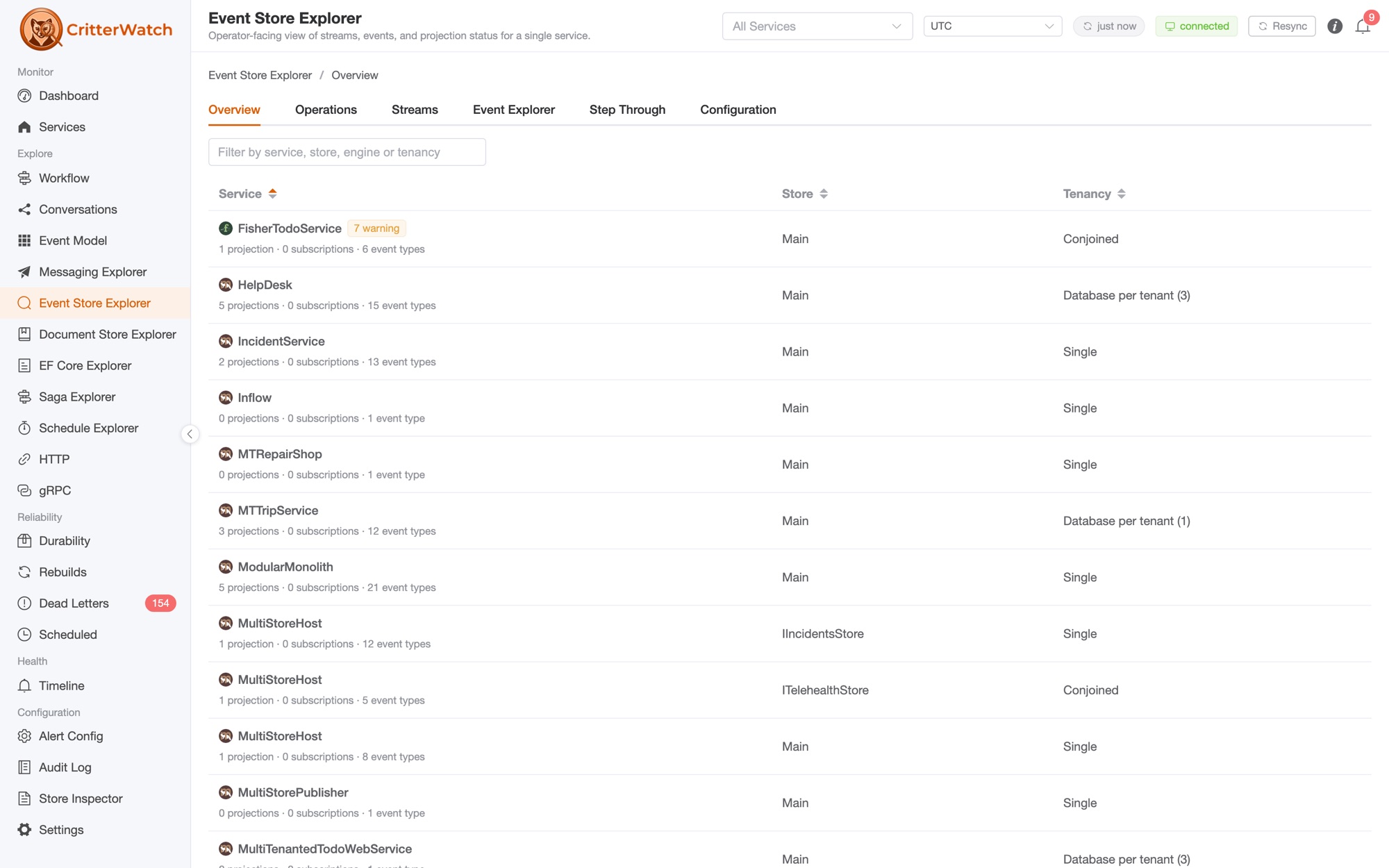 3rd November 2026CritterWatch 1.2: See Inside Your Event Store, Documents, Sagas and SchedulesCritterWatch 1.2 turns the console into a real explorer for what your Critter Stack services hold: an overview of every event store, a Step Through tab for projections, a Document Store Explorer that checks your documents still deserialize, saga instances with their state and pending timeouts, a Schedule Explorer that tells you what a schedule is actually doing, and an Event Model you can drill into.
Get help with Polecat
JasperFx builds and maintains Polecat. A support plan gives your team direct access to us; consulting and workshops get a project moving.
The Rest of the Stack
- MartenDocument database and event store on PostgreSQL
 WolverineCommand bus, message bus, and HTTP endpoints
 CritterWatchMonitoring and operations for the Critter Stack
 FisherEmbedded event store and document database on SQLite
 BobcatExecutable specifications and test supervision
 AlbaIntegration testing for ASP.NET Core
- WeaselSchema management for PostgreSQL, SQL Server, and SQLite
 AI SkillsDocumentation written for coding agents
- StoatThe design-time surface for Critter Stack development