Skip to content

Blog

Series
Managed Projection Distribution with the Critter Stack
17th November 2026

Managed Projection Distribution with the Critter Stack

Asynchronous projections are stateful, so each one has to run on exactly one node, keep running when that node dies, and not pile up on one unlucky pod. Here is how Wolverine distributes Marten and Polecat projection work across a cluster, fairly by default and with database affinity for multi-tenanted systems, and what CritterWatch adds on top: visualization, operator controls, a lot more health monitoring, MCP tools, and LLM alert triage.
16th November 2026

Indexing JSON Documents in Marten and Polecat

Storing documents as JSON doesn't mean giving up database indexes. A tour of the indexing options in Marten on PostgreSQL and Polecat on SQL Server: single property, multi-property, unique, partial, GIN and GiST indexes, how child collection queries use them, how both tools detect and migrate index changes, and how to read the SQL and the query plan to prove an index is being used.

13th November 2026

Tenants Taking Turns

A JasperFx client running thousands of tenants across hundreds of PostgreSQL databases was losing pods to out of memory kills during projection rebuilds. Here is how we worked through it together: partition the projection work by tenant, make the tenants take turns, and put a limit on the work in flight so one node can never load more than it can hold. Plus the other levers Marten gives you for very large systems, and how JasperFx works with clients on this kind of problem.

Decision Table Testing with Bobcat
12th November 2026

Decision Table Testing with Bobcat

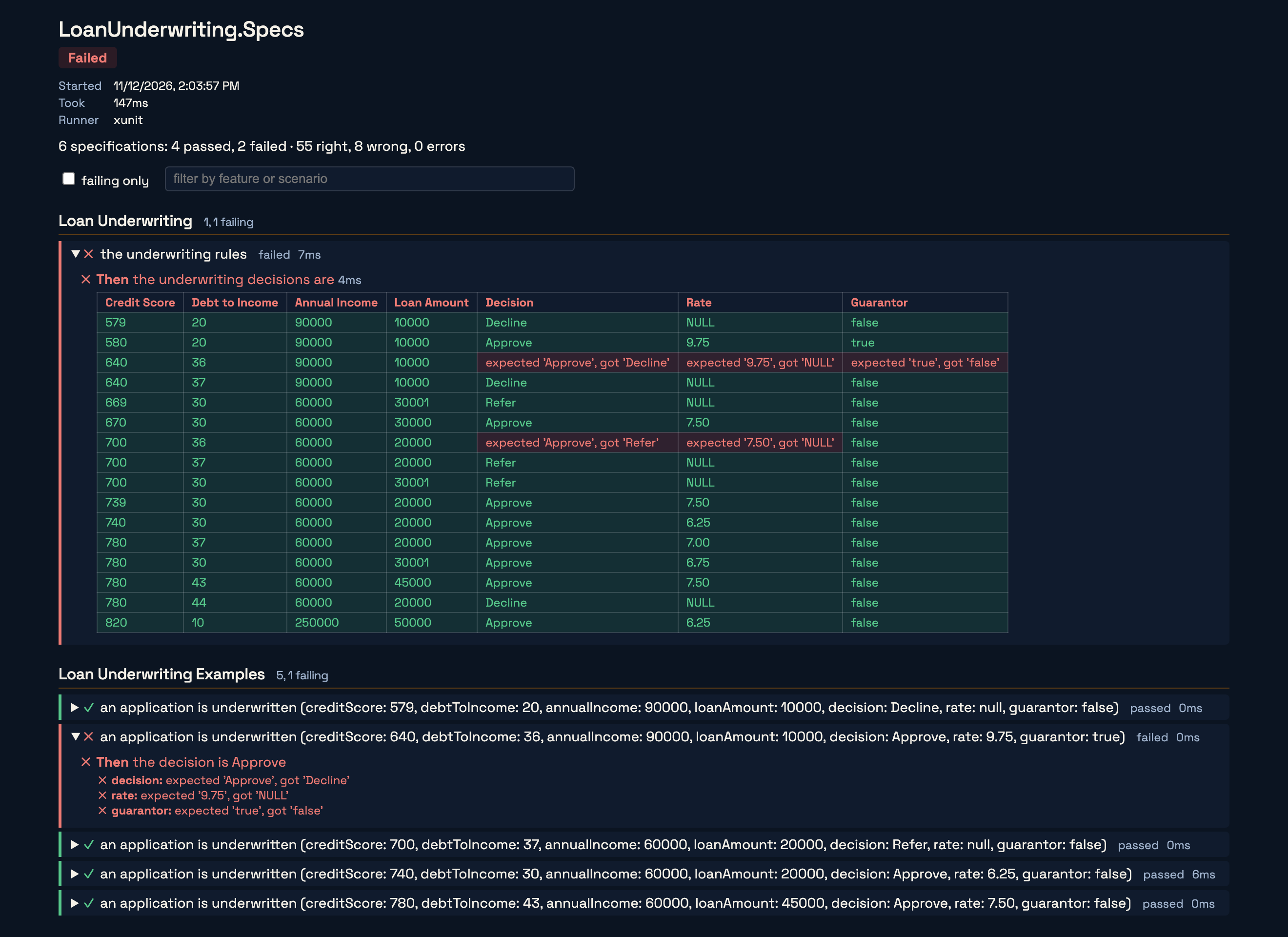
Some business rules are a decision tree: a handful of inputs, a handful of outputs, and a lot of boundaries where the answer changes. Here's how to test one with Bobcat as a table, with several expected values asserted on every row, what the output looks like when it passes and when it fails, and when to make every row its own test instead.

12th November 2026

Stoat: Memory for the Agents Working on Your Code

Every AI agent session starts from zero. Stoat gives the agents working on your codebase a shared, event sourced memory: decisions, gotchas and conventions recorded by one session and recalled by the next, scoped to a repository, a plan or everything. Here's how it works, and the full-text and vector search in Fisher, Marten and Polecat underneath it.

10th November 2026

Clone n' Go with Stateful Resources and Weasel

Every Critter Stack tool that touches a database knows exactly what that database should look like, and can make it so. This is the basics of how that works: the AutoCreate modes, the Weasel migration engine underneath Marten, Polecat, Fisher and Wolverine, the stateful resource model that puts databases and message brokers behind one interface, and the four ways to get a schema into place from a laptop to a DBA-owned production database.

+2
Our Plan for the Critter Stack on .NET 11
9th November 2026

Our Plan for the Critter Stack on .NET 11

JasperFx 3, Weasel 10, Marten 10, Polecat 6, Fisher 2, Wolverine 7 and CritterWatch 2 are all coming together on .NET 10 and .NET 11, and the headline is not the framework bump. It is the pile of opt-in defaults from the Wolverine 6.x and Marten 9.x lines that finally get to become the defaults, each with a single one-line opt-out. Here is what flips, why, what else is in the train, and how we are running the whole thing as one Stoat plan to dogfood Stoat before its 1.0.

8th November 2026

Improving Wolverine through Chaos Testing

Wolverine's durable inbox and outbox promise that a message is handled once even when processes die, databases go away and the network lies to you. Over the last couple of months we have been trying very hard to break that promise, with an out-of-process chaos rig that kills, pauses and starves real Wolverine nodes. Here is how the testing works, the message loss and duplication bugs it found, and what we did about every one of them.

Recurring Jobs with Wolverine and CritterWatch
4th November 2026

Recurring Jobs with Wolverine and CritterWatch

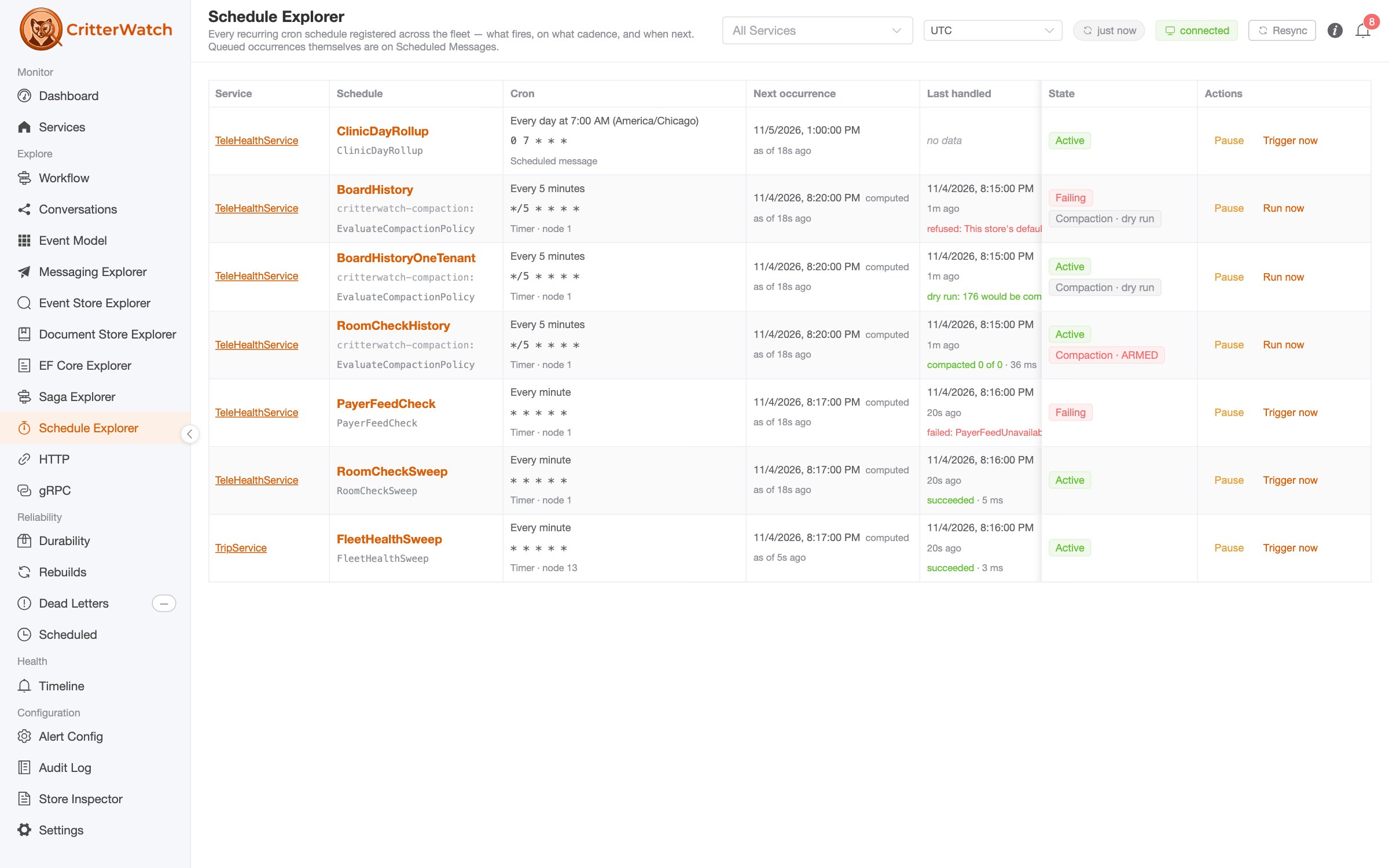
Every system has work that runs on a schedule. Wolverine turns a cron job into an ordinary message, so it gets the outbox, retries, dead letters, OpenTelemetry tracing and once-per-cluster execution for free, and CritterWatch 1.2 lets you see, pause, resume and trigger every schedule across your fleet. Plus how Wolverine treats a nightly job differently from one that fires every few seconds, and why.

Critter Stack AI Skills 1.18: Caught Up With CritterWatch 1.2
3rd November 2026

Critter Stack AI Skills 1.18: Caught Up With CritterWatch 1.2

AI Skills 1.18 brings every CritterWatch skill up to the 1.2 MCP tools, checked tool by tool against the source: a new sagas skill, the get_command_outcome tool, dead letters ranged by failure time, event queries over bodies and metadata, and six corrections to advice that had gone wrong, including the Prometheus series names every Grafana example used.

+3
CritterWatch 1.2: See Inside Your Event Store, Documents, Sagas and Schedules
3rd November 2026

CritterWatch 1.2: See Inside Your Event Store, Documents, Sagas and Schedules

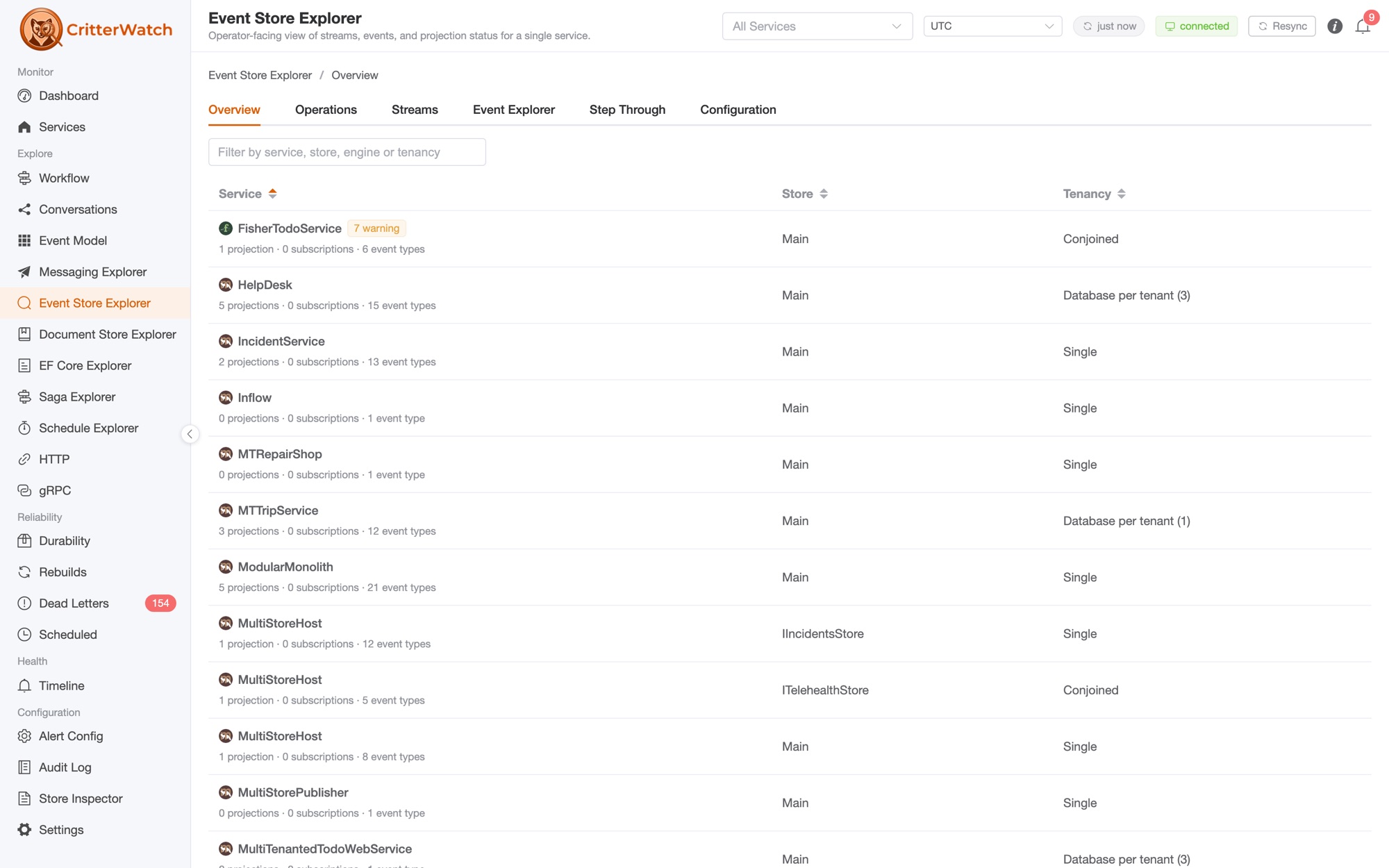
CritterWatch 1.2 turns the console into a real explorer for what your Critter Stack services hold: an overview of every event store, a Step Through tab for projections, a Document Store Explorer that checks your documents still deserialize, saga instances with their state and pending timeouts, a Schedule Explorer that tells you what a schedule is actually doing, and an Event Model you can drill into.

+1
2nd November 2026

Alba 9 Is Nearly Here

Alba 9.0 RC3 is the last release candidate before the biggest release Alba has had in years: host pooling for parallel integration tests, scenarios addressed by route name, JSON path and problem details assertions, endpoint coverage and authorization audits, time travel with a fake TimeProvider, server-sent events, and a rebuilt docs site. All of it is Jaedyn's work. Plus the breaking changes to read before you upgrade from Alba 8.