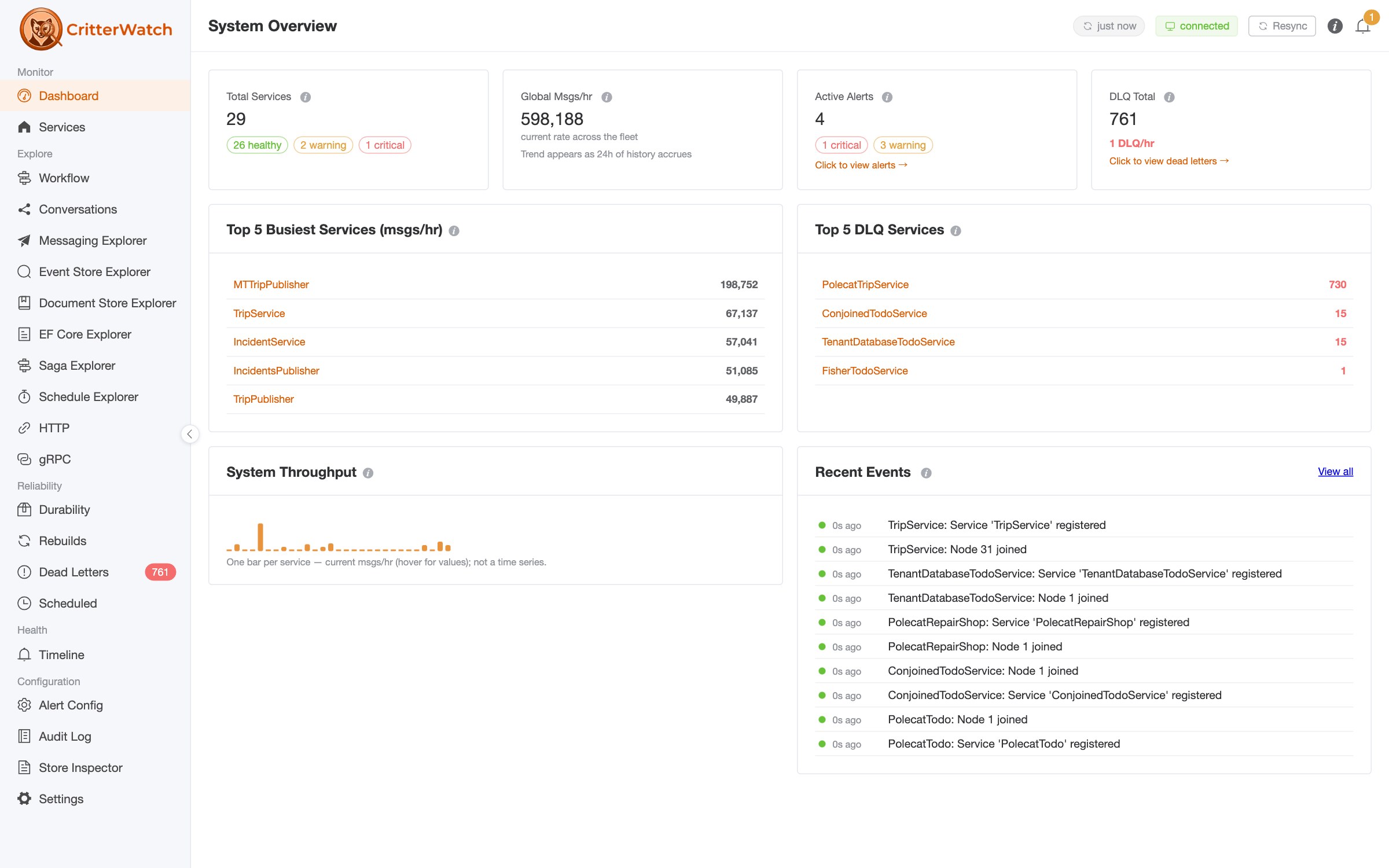
We published Critter Stack AI Skills 1.18 today, alongside CritterWatch 1.2 and its 1.2.1 follow-up. The catalog is now 127 skills, with one new one, and 22 existing skills changed.
How it was checked
Every MCP tool CritterWatch 1.2 ships, 88 of them, was compared with what the skills say about it. Then every change to those tools since 1.1.1, parameter by parameter, was checked against the skill that teaches it. Where the code and our own notes disagreed, the code won. That is how the review found one tool no skill mentioned at all, and a reference to a tool that has never existed.
It also found a defect in CritterWatch itself: on a 1.2.0 console with RBAC enforced, the MCP projection stepper was refused for every caller. That is fixed in CritterWatch 1.2.1, released today, and the skill tells a 1.2.0 user what to do in the meantime.
What CritterWatch 1.2 added for agents
- Did that command actually work? Every MCP action that relays a command to a service now returns a
correlationIdandhostOutcome: "unknown". The newget_command_outcometool reads back any failure the service reported, a license refusal included. It can never report success, because only failures are recorded, so the skills say how to confirm each action's effect, and which refusals the lookup cannot see. - Sagas. A new skill,
wolverine-integrations-critterwatch-sagas, teacheslist_sagas,list_saga_instancesandget_saga_instance: querying instances by their own state, what each saga storage can filter, and one instance's state, handled messages and pending timeouts. It also says plainly that an unordered page of instances is not "the most recent ones". - Dead letters ranged by when they failed, with
failedAton every entry andrangedOnsaying which time an answer used, so an agent can tell you when an older service could only range on the sent time. Agents can also write a failure group's note now, for the next operator. - Conversations that start at the HTTP request, projection side effects joined to the conversation that caused them, and two new completeness fields an agent must report rather than paper over.
- Event queries with a
whereandorderByover event bodies or event metadata, and what each one refuses. - Listener commands that reach every node, and the refusals for a queue that cannot pause or an endpoint the service does not have.
Six places the skills had gone wrong
- The license. The setup skill said
Wolverine.CritterWatchis MIT. Every CritterWatch package is under the Business Source License; read-only monitoring needs no key, and the skill now says exactly where one is needed. - Per-tenant permissions. The tenant tools check their capability against the tenant, not the service, and a scoped grant names the agent URI with the tenant appended. Two skills described it wrongly.
- Every Prometheus query. The Grafana and metrics skills used series names Wolverine does not export. The real names carry their units (
wolverine_execution_time_Milliseconds_bucket,wolverine_inbox_count_Messages), use thesourcelabel rather thanjob, and the three persistence gauges have nosourcelabel at all. Every example and alert rule is rewritten against a board verified on a live fleet. - Polecat's MCP endpoint.
MapPolecatMcpis obsolete. The skills now point atPolecat.Mcp'sAddPolecatMcp()andMapPolecatMcpServer(). - A tool that never existed. The dead-letter skill sent agents to an operation-read tool CritterWatch has never had.
- Alerts. Baselines are not typed into a settings screen, the auto-resolving alert types do auto-resolve, and a baseline is service-wide.
And the rest
The alerts skill covers PagerDuty and email paging, the runtime-pressure and document-watch alerts, and per-message-type thresholds, including the metrics sources where they are not evaluated. The Stoat skills cover a repository's own gates and standing in for CI, holds and session limits, and skills on a plan node. Every change is listed on the What's New page.
Installing it
dotnet tool install --global agentskills-cli
agentskills-cli add JasperFx.AiSkills -g -a universal -a claude-code -y
The skills are commercially licensed, with annual tiers by team size on the AI Skills section of our products page, and bundled into every JasperFX support plan. Questions and bug reports go to JasperFx/ProductSupport.