
CritterWatch

Commercial · JasperFx
CritterWatch
Monitoring and operations for the Critter Stack
From dev-time insight to production control for Wolverine, Marten, and Polecat - for you and your AI agents.
CritterWatch reads the telemetry your Critter Stack services already emit and turns it into a console that answers the questions Prometheus and Grafana cannot: which listener is latched, why a projection is behind, which dead letters share a cause, and whether last night's scheduled job ran. Then it lets you act, from replaying a failure group to pausing a schedule, with an audit trail.
Every operation is also exposed through an MCP server, so an AI agent can triage an incident with the same tools an operator uses, and still has to show you the preview before anything is deleted. Run it standalone or embedded inside the application you already deploy.
The Community tier is free for development and small fleets. Professional and Enterprise licenses bundle the AI Skills, and a 30-day trial unlocks every feature with no credit card.
What CritterWatch Gives You
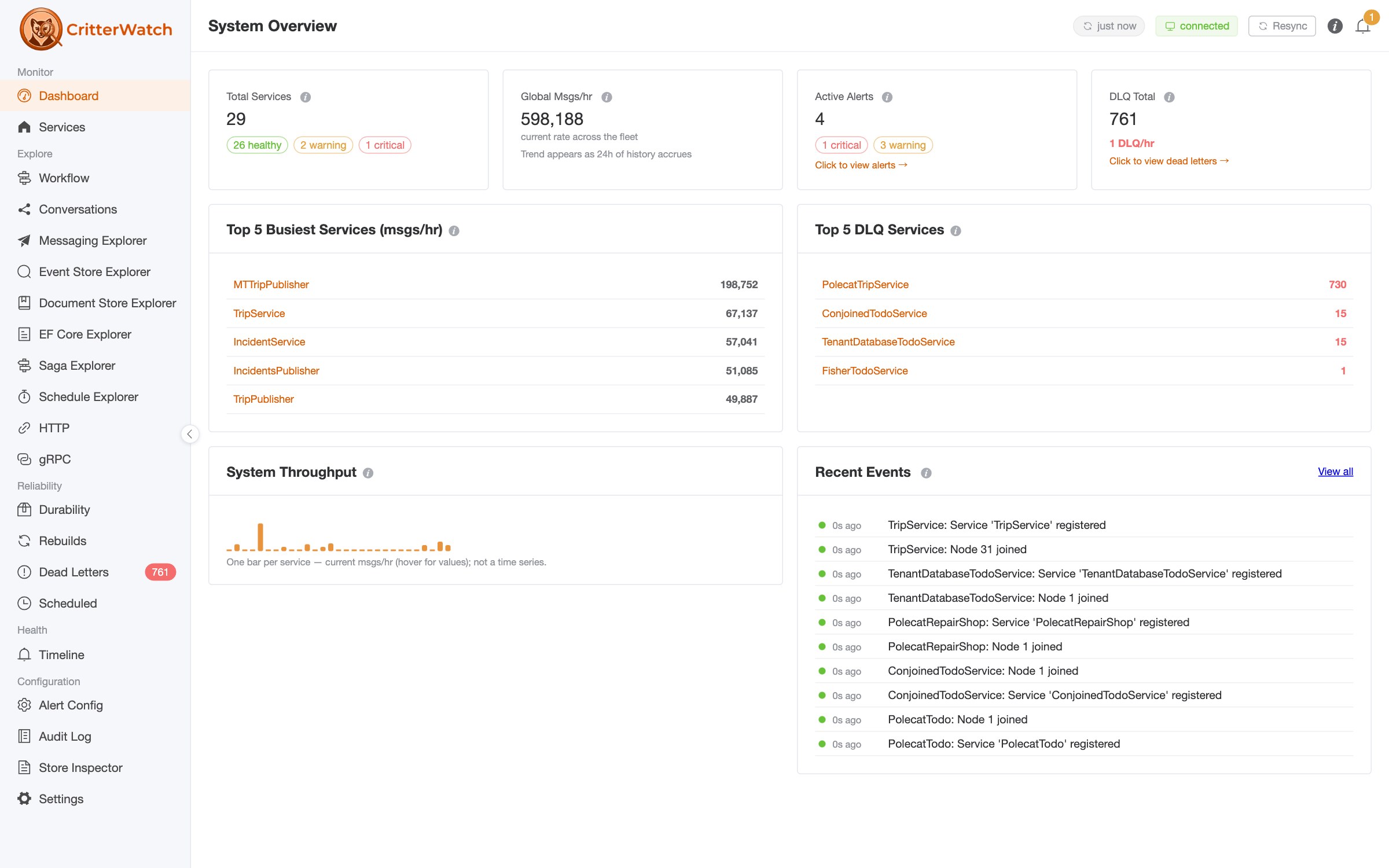
Fleet dashboard
Every service, node, agent, and listener across your fleet, with the health, throughput, and failure signals that matter.
Dead letter management
Failure groups that treat one incident as one thing, bulk replay with a full audit log, and edit-and-replay for the message that was wrong.
Event store and projections
Step through any event stream, watch projections catch up, rebuild them without downtime, and run compaction policies.
Alerts, schedules, and tenants
Custom thresholds, a timeline of what changed, control of recurring jobs, and tenant onboarding without a deployment.
Explorers
Browse documents, saga instances, scheduled messages, and the Event Model of your system as it actually runs.
Built for AI agents
An MCP server with the same operations as the console, paired with the AI Skills that teach agents how to use them safely.
Start Here
New to CritterWatch? These 5 posts are the ones to read first, in order.
- 1CritterWatch 1.0: Stop Guessing What Your Critter Stack Is DoingCritterWatch 1.0 is here — a monitoring and production-management console purpose-built for Wolverine, Marten, Polecat, and Fisher. It renders the system you actually shipped from the running code, steps through projections event by event, lets you replay dead letters and rebuild projections without a redeploy, and hands your AI agent a real, RBAC-gated control surface.
- 2Interrogating Your Running System with CritterWatch's MCP ServerA real, recorded session of an AI agent triaging a Wolverine system through CritterWatch's MCP server — summarizing and replaying dead letters, explaining a message's full journey from its OpenTelemetry spans, chasing down a poisoned projection with the projection stepper, and interrogating the alert subsystem. Plus how the JasperFx AI Skills teach the agent to do all of this well.
- 3Alerts and the Timeline in CritterWatch 1.0CritterWatch 1.0 is watching your system for unusual conditions and trying to explain the cause and effect of anything that's going wrong.
- 4Dead Letter Management in CritterWatch 1.1Bulk replay that acts on exactly what it counted, edit-and-replay with a full audit trail, every operation followed to the end across every database, and an MCP server that lets an AI agent triage your dead letters, but asks before it deletes anything.
- 5CritterWatch 1.2: See Inside Your Event Store, Documents, Sagas and SchedulesCritterWatch 1.2 turns the console into a real explorer for what your Critter Stack services hold: an overview of every event store, a Step Through tab for projections, a Document Store Explorer that checks your documents still deserialize, saga instances with their state and pending timeouts, a Schedule Explorer that tells you what a schedule is actually doing, and an Event Model you can drill into.
Latest on CritterWatch
21 posts from the JasperFx blog cover CritterWatch. Here are the most recent.
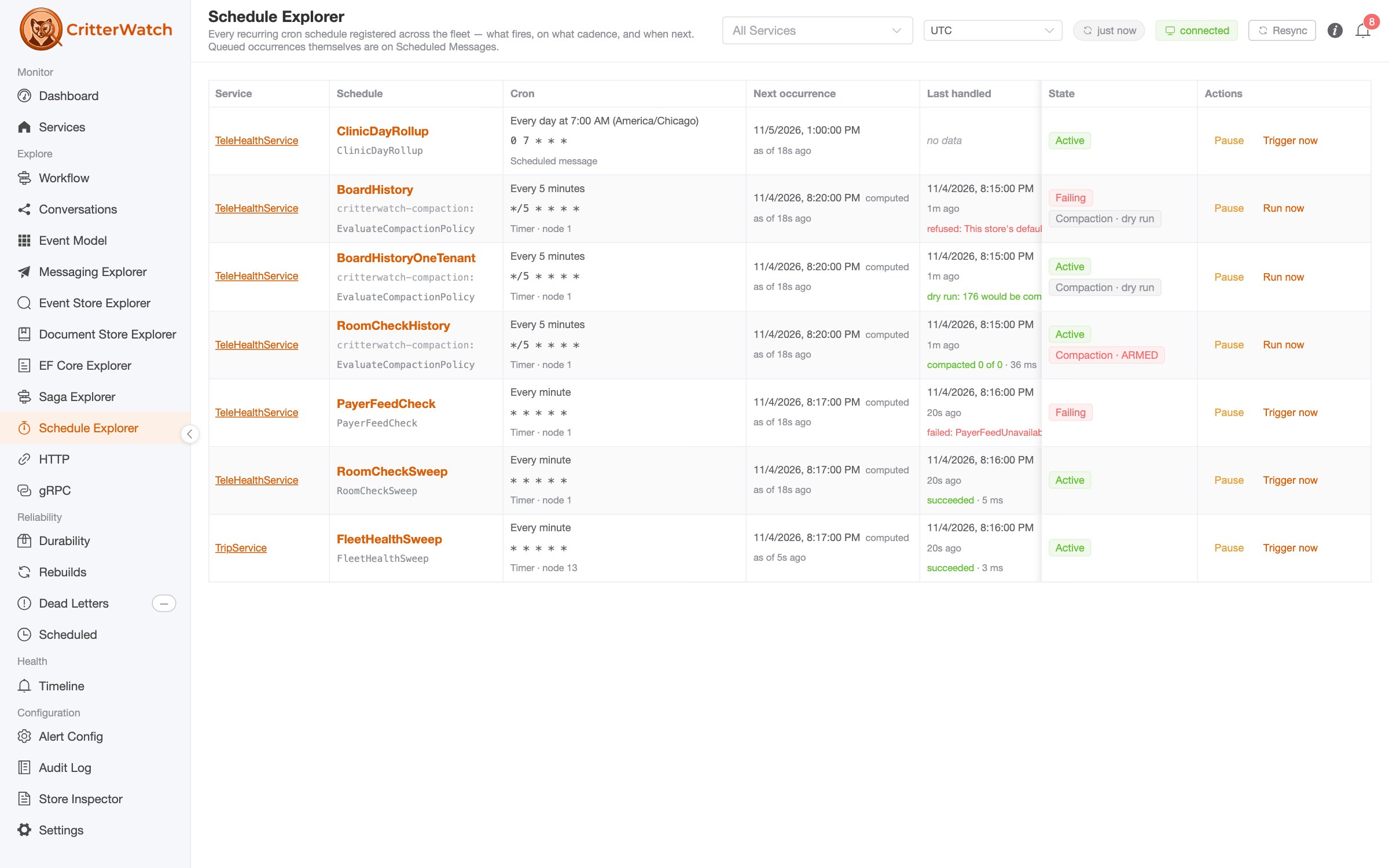 4th November 2026Recurring Jobs with Wolverine and CritterWatchEvery system has work that runs on a schedule. Wolverine turns a cron job into an ordinary message, so it gets the outbox, retries, dead letters, OpenTelemetry tracing and once-per-cluster execution for free, and CritterWatch 1.2 lets you see, pause, resume and trigger every schedule across your fleet. Plus how Wolverine treats a nightly job differently from one that fires every few seconds, and why.
 3rd November 2026Critter Stack AI Skills 1.18: Caught Up With CritterWatch 1.2AI Skills 1.18 brings every CritterWatch skill up to the 1.2 MCP tools, checked tool by tool against the source: a new sagas skill, the get_command_outcome tool, dead letters ranged by failure time, event queries over bodies and metadata, and six corrections to advice that had gone wrong, including the Prometheus series names every Grafana example used.
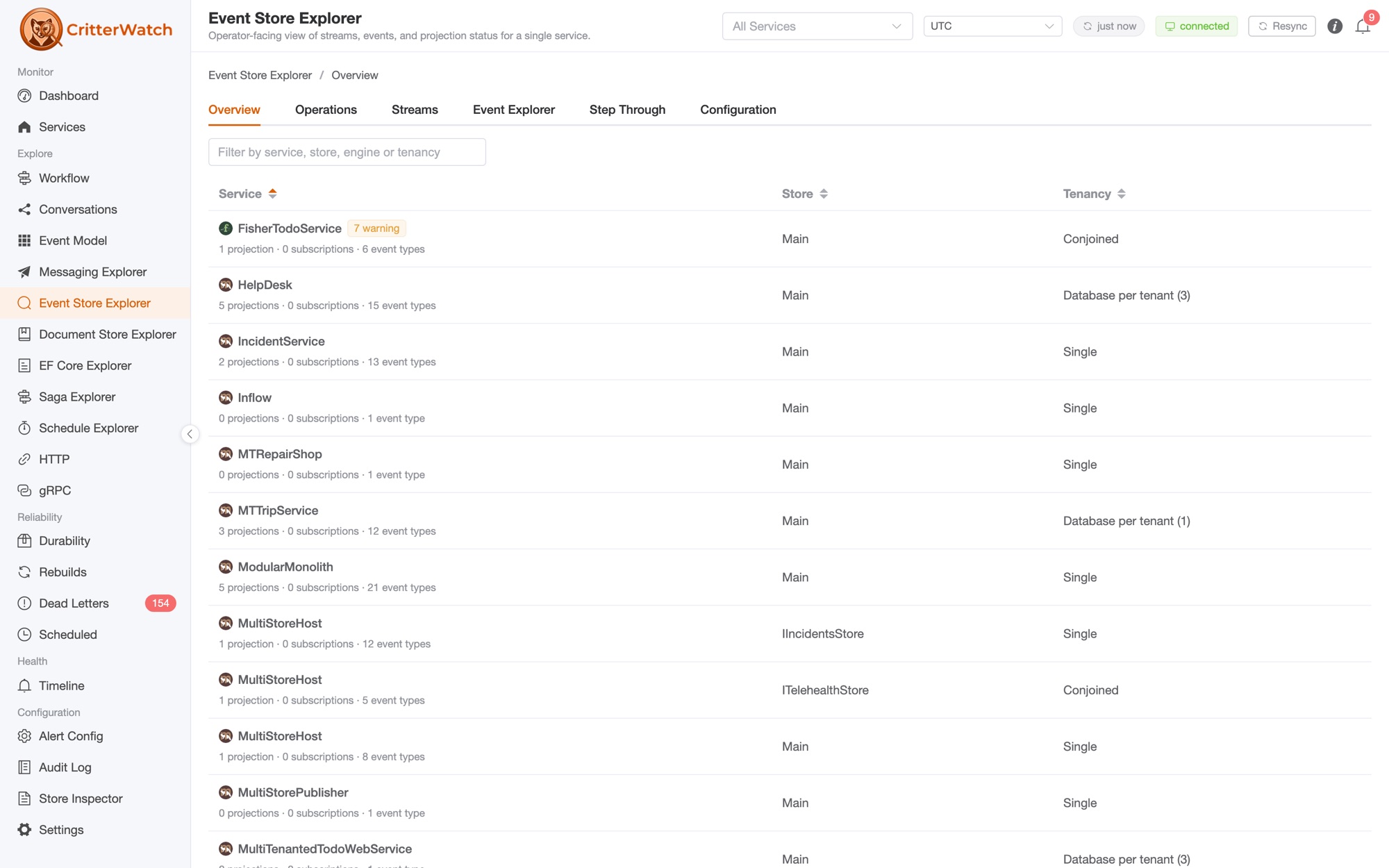 3rd November 2026CritterWatch 1.2: See Inside Your Event Store, Documents, Sagas and SchedulesCritterWatch 1.2 turns the console into a real explorer for what your Critter Stack services hold: an overview of every event store, a Step Through tab for projections, a Document Store Explorer that checks your documents still deserialize, saga instances with their state and pending timeouts, a Schedule Explorer that tells you what a schedule is actually doing, and an Event Model you can drill into.
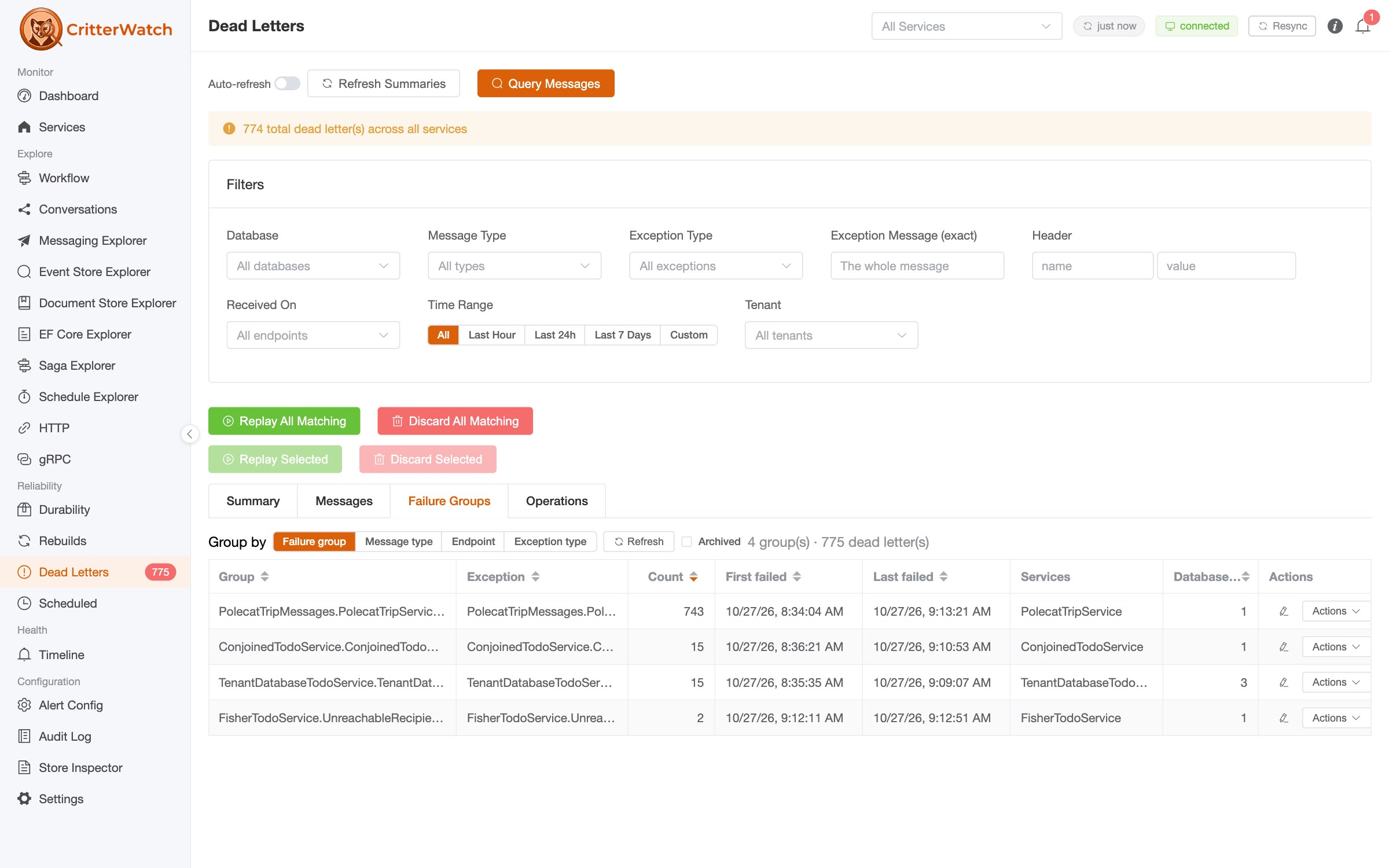 29th October 2026Failure Groups: Handle a Dead Letter Incident as One ThingCritterWatch 1.1 groups dead letters by the failure that caused them, across every service and database, and lets you replay, archive, restore or discard the whole group as one tracked operation with a reason attached. Your AI agent gets the same loop over MCP, and still has to show you the preview before it deletes anything.
 27th October 2026CritterWatch 1.1, Bobcat 1.0, AI Skills 1.17, and a First Look at StoatOne release wave, four products: CritterWatch 1.1 with 83 MCP tools, cron schedules, a Document Explorer and a long list of scalability fixes earned on real systems; Bobcat 1.0, the successor to Storyteller and our answer for spec-driven development; AI Skills 1.17; and the first public preview of Stoat.27th October 2026Critter Stack AI Skills 1.17: One Month of Releases, Checked Against the SourceAI Skills 1.17 is the result of a review of everything Wolverine, Marten, CritterWatch, Bobcat and Stoat shipped in the last month, checked against the product source rather than the changelogs. Thirty-six skill changes, seven of them correcting advice that had quietly gone wrong, and the CritterWatch 1.1 paired updates that were waiting in 1.16.
Questions about CritterWatch?
Talk to us about licensing, rollout, or how CritterWatch fits your team.
The Rest of the Stack
 MartenDocument database and event store on PostgreSQL
 WolverineCommand bus, message bus, and HTTP endpoints
 PolecatEvent store and document database on SQL Server 2025
 FisherEmbedded event store and document database on SQLite
 BobcatExecutable specifications and test supervision
 AlbaIntegration testing for ASP.NET Core
 WeaselSchema management for PostgreSQL, SQL Server, and SQLite
 AI SkillsDocumentation written for coding agents
 StoatThe design-time surface for Critter Stack development