Skip to content 17th November 2026Managed Projection Distribution with the Critter StackAsynchronous projections are stateful, so each one has to run on exactly one node, keep running when that node dies, and not pile up on one unlucky pod. Here is how Wolverine distributes Marten and Polecat projection work across a cluster, fairly by default and with database affinity for multi-tenanted systems, and what CritterWatch adds on top: visualization, operator controls, a lot more health monitoring, MCP tools, and LLM alert triage.
 13th November 2026Tenants Taking TurnsA JasperFx client running thousands of tenants across hundreds of PostgreSQL databases was losing pods to out of memory kills during projection rebuilds. Here is how we worked through it together: partition the projection work by tenant, make the tenants take turns, and put a limit on the work in flight so one node can never load more than it can hold. Plus the other levers Marten gives you for very large systems, and how JasperFx works with clients on this kind of problem.
 7th October 2026Wolverine's End to End Multi-TenancyWolverine treats the tenant id as message metadata, and that one decision carries the tenant from HTTP detection, into the right Marten, Polecat, or EF Core session, onto every cascaded message, and into the only transactional inbox and outbox in .NET that lives in each tenant's own database. Here's how the whole chain works, and why it took years to get right.22nd September 2026Multi-Tenancy with EF Core is a Whole Lot Easier with WolverineEF Core query filters and dynamic connection strings are the raw ingredients for multi-tenancy. Wolverine turns them into a finished dish: conjoined tenancy with zero filter plumbing, database per tenant, tenants added at runtime, HTTP tenant detection that flows straight into DbContext construction, a transactional inbox/outbox per tenant database, tenant ids that ride along on every cascaded message, and 'it just works' schema migrations across every tenant database.21st September 2026Every Lever Marten Gives You for Scaling a Big Event Sourcing SystemA tour of everything in Marten and Wolverine for scaling large event sourced systems: Quick Append, hot/cold event archiving, stream compacting, binary event serialization, read replicas, per-tenant partitioning, database per tenant and sharding, ancillary stores per module, projection lifecycles, strongly consistent async projections, partitioned projection data, and Wolverine-managed projection distribution.4th August 2026One Application, Many Brokers: Wolverine's Multi-Transport and Broker-per-Tenant StoryReal systems rarely get to standardize on one message broker. Wolverine lets a single application speak Rabbit MQ, Azure Service Bus, Kafka, and MQTT at once — and takes it one step further with a broker-per-tenant model where the tenant id is inferred from the connection a message arrived on and carried all the way into the database transaction.
 2nd August 2026A Week in the Critter Stack: Security, Preventing Data Loss, and Rolling PartitionsSeven days, twenty-two releases across Marten, Wolverine, Polecat, Weasel, and JasperFx: a PostgreSQL injection fix under sharded tenancy, two silent data-loss bugs in Wolverine, self-managing time-series partitions, and a big wave of production hardening for projection agent distribution.
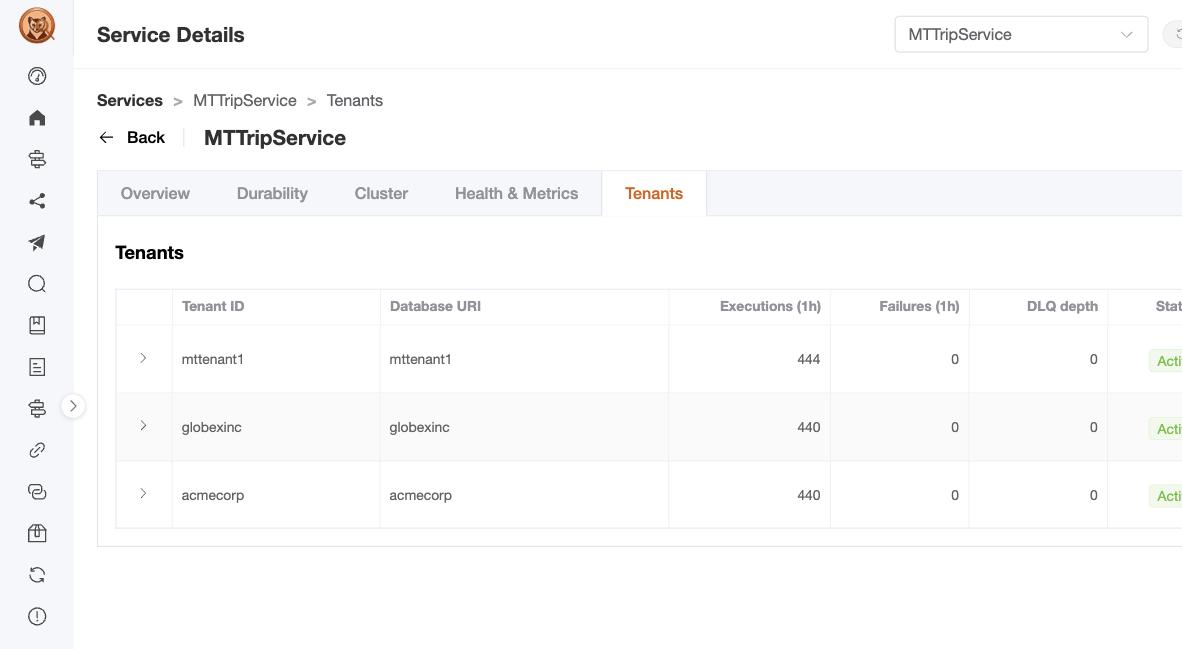 28th July 2026Onboard a Tenant Without a Deployment: Runtime Multi-Tenancy in CritterWatchCritter Stack services can add, disable, and remove tenants at runtime — new databases and all. CritterWatch turns that capability into an operator console: a tenant lifecycle you can drive from a browser, and performance metrics broken down per tenant id.
 5th January 2025Jeremy on Multi-Tenancy with CodeOpinionJeremy joins Derek Comartin of CodeOpinion for a wide ranging conversation on multi-tenancy strategies.

Multi-Tenancy
Posts tagged Multi-Tenancy
17th November 2026Managed Projection Distribution with the Critter StackAsynchronous projections are stateful, so each one has to run on exactly one node, keep running when that node dies, and not pile up on one unlucky pod. Here is how Wolverine distributes Marten and Polecat projection work across a cluster, fairly by default and with database affinity for multi-tenanted systems, and what CritterWatch adds on top: visualization, operator controls, a lot more health monitoring, MCP tools, and LLM alert triage.13th November 2026Tenants Taking TurnsA JasperFx client running thousands of tenants across hundreds of PostgreSQL databases was losing pods to out of memory kills during projection rebuilds. Here is how we worked through it together: partition the projection work by tenant, make the tenants take turns, and put a limit on the work in flight so one node can never load more than it can hold. Plus the other levers Marten gives you for very large systems, and how JasperFx works with clients on this kind of problem.7th October 2026Wolverine's End to End Multi-TenancyWolverine treats the tenant id as message metadata, and that one decision carries the tenant from HTTP detection, into the right Marten, Polecat, or EF Core session, onto every cascaded message, and into the only transactional inbox and outbox in .NET that lives in each tenant's own database. Here's how the whole chain works, and why it took years to get right.22nd September 2026Multi-Tenancy with EF Core is a Whole Lot Easier with WolverineEF Core query filters and dynamic connection strings are the raw ingredients for multi-tenancy. Wolverine turns them into a finished dish: conjoined tenancy with zero filter plumbing, database per tenant, tenants added at runtime, HTTP tenant detection that flows straight into DbContext construction, a transactional inbox/outbox per tenant database, tenant ids that ride along on every cascaded message, and 'it just works' schema migrations across every tenant database.21st September 2026Every Lever Marten Gives You for Scaling a Big Event Sourcing SystemA tour of everything in Marten and Wolverine for scaling large event sourced systems: Quick Append, hot/cold event archiving, stream compacting, binary event serialization, read replicas, per-tenant partitioning, database per tenant and sharding, ancillary stores per module, projection lifecycles, strongly consistent async projections, partitioned projection data, and Wolverine-managed projection distribution.4th August 2026One Application, Many Brokers: Wolverine's Multi-Transport and Broker-per-Tenant StoryReal systems rarely get to standardize on one message broker. Wolverine lets a single application speak Rabbit MQ, Azure Service Bus, Kafka, and MQTT at once — and takes it one step further with a broker-per-tenant model where the tenant id is inferred from the connection a message arrived on and carried all the way into the database transaction.2nd August 2026A Week in the Critter Stack: Security, Preventing Data Loss, and Rolling PartitionsSeven days, twenty-two releases across Marten, Wolverine, Polecat, Weasel, and JasperFx: a PostgreSQL injection fix under sharded tenancy, two silent data-loss bugs in Wolverine, self-managing time-series partitions, and a big wave of production hardening for projection agent distribution.28th July 2026Onboard a Tenant Without a Deployment: Runtime Multi-Tenancy in CritterWatchCritter Stack services can add, disable, and remove tenants at runtime — new databases and all. CritterWatch turns that capability into an operator console: a tenant lifecycle you can drive from a browser, and performance metrics broken down per tenant id.5th January 2025Jeremy on Multi-Tenancy with CodeOpinionJeremy joins Derek Comartin of CodeOpinion for a wide ranging conversation on multi-tenancy strategies.